1.Introduction
Showing your own home is one of the most personal parts of selling privately in Ontario. You are inviting strangers into a place that may contain your valuables, documents, children’s belongings, work equipment, medication, spare keys, and everyday routines.
You do not need to make serious buyers jump through unreasonable hoops. But you also do not need to let someone into your home simply because they sent a short message saying they are interested.
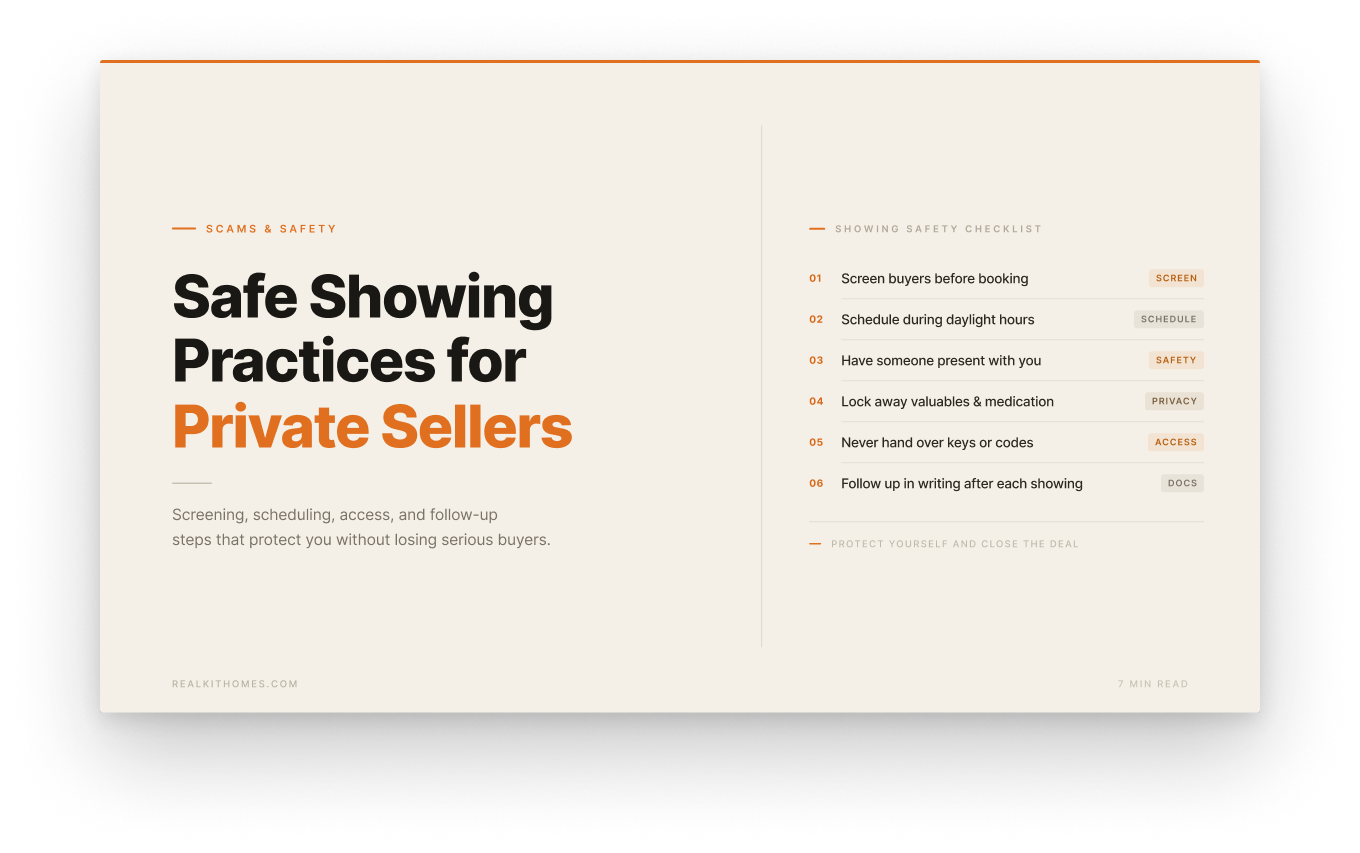
A safer private showing process is straightforward: collect basic information before booking, use scheduled appointments, protect your belongings and personal information, keep control of entry and access, maintain a visitor record, and follow up through one organized channel.
These steps also make your sale look more professional. Serious buyers and buyer agents generally expect clear showing instructions, prompt confirmations, accurate property information, and reasonable boundaries.
2.Table of Contents
- Why a showing plan matters for private sellers
- Set your rules before the listing goes live
- Screen inquiries before booking a visit
- Use scheduled appointments and confirmations
- Protect valuables, documents, and digital privacy
- Manage access without leaving your home unsecured
- Decide who should be present during a showing
- Safer open houses and group viewings
- Showing condos, tenanted homes, and rural properties
- Keep a visitor record and organize follow-up
- Recognize common private-sale warning signs
- What to do when a buyer wants to make an offer
- How Realkit helps organize private showings
- Frequently Asked Questions
- Conclusion
- Sources
3.Why a Showing Plan Matters for Private Sellers
Private showings are where your listing becomes a real transaction. A buyer moves from looking at photos to inspecting rooms, testing the layout, asking questions, and deciding whether they may want to make an offer.
That is also when a seller has the least control if there is no plan.
A disorganized showing process can lead to:
- Unannounced visitors at your door
- Conflicting appointments
- Buyers entering without you knowing who they are
- Personal documents being left in plain sight
- Lost track of who has seen the home
- Confusing conversations about price or terms
- Missed follow-up with serious buyers
- Unsafe situations for you or anyone else in the home
The aim is not to treat every visitor as suspicious. It is to establish normal seller boundaries before you are under pressure from an interested buyer.
Safety and professionalism support each other
A clear showing process is good business.
For example, a buyer agent who receives a confirmed time, parking instructions, entry details, and a list of available property documents is more likely to see the seller as organized. A buyer who is asked to come by “anytime after 5” may arrive when the home is not ready, when you are alone, or when another visitor is already there.
Think of your showing procedure as part of your listing operation, not as a separate safety task.
4.Set Your Rules Before the Listing Goes Live
Do not create your showing rules after inquiries start arriving. Decide what you are comfortable with before you publish the listing.
Your rules might include:
- Showings are by appointment only
- Visitors must provide a full name and contact information
- Buyer agents must identify themselves and their brokerage
- You confirm the number of people attending
- Visitors do not arrive more than a few minutes early
- You do not leave keys, lockbox codes, or access codes unattended
- You do not allow unattended visits
- You do not allow photography or video without your permission
- You keep bedrooms, offices, storage areas, garages, and utility spaces supervised where practical
- You will not negotiate or accept a serious offer without written documentation and lawyer review
Write these rules down for yourself. You do not need to send every rule to a buyer, but having them in place makes it easier to respond consistently.
Choose realistic showing windows
Pick showing times that work with your household and your availability.
For example:
- Weekday evenings may work for buyers, but avoid opening your home late at night if that makes you uncomfortable
- Weekend blocks can reduce repeated cleaning and allow you to arrange for another adult to be present
- If you work from home, avoid showing slots that reveal confidential work materials or interrupt meetings
- If you have children, consider showing windows when they are not home
- If you have pets, plan where they will be before accepting appointments
Avoid an open-ended promise that your home can be shown at any time. A smaller number of reliable, well-managed appointments is better than a long series of rushed or poorly controlled visits.
5.Screen Inquiries Before Booking a Visit
A buyer does not need to provide every financial document before seeing your home. But you should know who is coming and have a reliable way to contact them.
Before confirming a showing, ask for:
- Full name
- Mobile number and email address
- Preferred showing date and time
- Number of attendees
- Whether they are working with a buyer agent
- The agent’s name and brokerage, if applicable
- Whether they have questions about the listing before viewing
This is not a formal identity-verification process. It is a practical way to avoid anonymous visits and create a record of who is expected.
A simple screening message
You can use a brief message such as:
“Thanks for your interest. Showings are by appointment. Please send your full name, mobile number, preferred time, and the name and brokerage of your buyer agent if you are working with one. We will confirm a time and provide parking and entry instructions.”
Keep the message neutral and consistent. You do not need to ask personal questions that are unrelated to the sale.
How to handle buyer agents
A buyer agent may ask to book through text, email, or a showing service. Ask for the agent’s name, brokerage, contact details, and the name of the buyer attending.
You can also confirm:
- Whether the buyer will attend in person
- How many people will be coming
- Whether the agent wants documents before the showing
- Whether the buyer has a preferred offer timeline
A buyer agent is representing the buyer, but clear communication can make showings smoother. Sellers who understand that relationship can better manage questions, access, compensation discussions, and potential offers.
When not to book immediately
It is reasonable to pause before booking if someone:
- Refuses to provide a name or callback number
- Insists on visiting without an appointment
- Wants a late-night showing that does not work for you
- Pressures you to send an access code
- Gives inconsistent information about who will attend
- Is hostile when you ask basic scheduling questions
- Wants to bring a large, undefined group through the home
- Starts demanding personal information unrelated to the property
You do not need to accuse anyone of being unsafe. You can simply say that your showing policy requires a confirmed appointment and basic visitor details.
6.Use Scheduled Appointments and Confirmations
A confirmed appointment gives you time to prepare the home, secure private materials, arrange support, and avoid overlapping visitors.
For every showing, record:
- Visitor or agent name
- Mobile number and email
- Date and start time
- Number of expected visitors
- Whether the visitor is represented
- Parking instructions provided
- Entry instructions provided
- Questions or documents requested
- Whether the appointment was confirmed
Confirm close to the showing time
Send a short confirmation on the day of the showing.
For example:
“Your showing is confirmed for 6:30 p.m. today. Please park in the driveway or on the street where permitted. Please message when you arrive and use the front entrance. The showing is scheduled for 30 minutes.”
A confirmation reduces no-shows and lets you identify whether the visitor is arriving as expected.
If the person does not confirm, you can decide whether you are comfortable holding the appointment. Do not leave the home open or unattended for someone who has not confirmed.
Avoid overlapping appointments where possible
Back-to-back showings can be efficient, but leave enough time for one party to exit before another arrives. Overlapping private appointments can make it difficult to know who belongs in the home and can create uncomfortable interactions.
If you want concentrated showing windows, schedule defined slots. For example, four 25-minute appointments with five-minute gaps are easier to manage than telling everyone to arrive between 1:00 and 3:00 p.m.
7.Protect Valuables, Documents, and Digital Privacy
Buyers need to see the property. They do not need access to your personal information.
Before every showing, remove or secure:
- Passports, birth certificates, tax returns, bank statements, chequebooks, and insurance papers
- Mail, prescription labels, and school documents
- Laptops, tablets, external drives, and work devices
- Jewellery, cash, collectible items, and small valuables
- Spare keys, garage remotes, fobs, and access cards
- Prescription medication
- Personal photographs if they reveal information you prefer to keep private
- Alarm codes, smart-home passwords, Wi-Fi passwords, and security-camera controls
Do not rely on hiding an item in a desk drawer. If it is important, remove it from the home or place it in a properly secured location.
Check before listing photos are taken
Privacy protection begins before the first showing.
Review your listing photos for:
- Family names on mail, awards, school uniforms, or children’s artwork
- House numbers where you prefer not to publish them widely
- Alarm panels, camera locations, and key hooks
- Computer screens or documents
- Vehicle licence plates
- Personal schedules or calendars
- Medication, personal care records, or health information
The same check applies to virtual tours and video walkthroughs. Once an image is shared online, it can be copied and distributed beyond your original listing.
Secure smart-home access
If you use a smart lock, camera, doorbell, thermostat, garage-door controller, or other connected device, review how it works before showings begin.
Practical steps include:
- Do not share permanent access codes
- Change temporary codes promptly if you use them
- Check who has access to your smart-home accounts
- Remove old contractor, cleaner, or former tenant access
- Ensure garage remotes and fobs are accounted for
- Do not rely on an app notification as your only way to monitor entry
If a buyer asks how a smart-home feature works, you can explain it during a supervised showing without sharing account credentials or passwords.
8.Manage Access Without Leaving Your Home Unsecured
The safest default is simple: keep control of the door and know who is entering.
That usually means meeting visitors at the entrance, confirming their identity against the appointment record, and allowing them in once you know they are the expected party.
Do not send access codes casually
Avoid sending a door code, garage code, lockbox code, or building access code by text simply because someone says they are running late.
A code can be forwarded, reused, or saved. It also gives you less control over who enters and when.
If a buyer agent needs access, arrange a process that lets you confirm the appointment and maintain control. If the property is vacant, take additional care. Vacant homes can be more difficult to monitor, particularly if keys, lockboxes, or access codes are left in place for repeated showings.
Be cautious with lockboxes
A lockbox can be convenient, but it is not a complete safety plan.
Before using one, decide:
- Who will have access
- How they will be authorized
- Whether the key is only available for confirmed appointments
- How often you will check that the key is present
- What happens if a showing is cancelled
- Whether another person has a backup key
- How you will change access after the listing ends
If you are not comfortable with a lockbox, you can use scheduled, seller-attended showings instead.
Keep the exit clear
During the showing, avoid positioning yourself in a way that blocks your own route to the front door or another exit.
You do not need to follow visitors closely through every room. But stay aware of who is in the property, avoid being isolated in a basement or locked room with an unfamiliar visitor, and keep your phone accessible.
If a visitor behaves in a way that makes you uncomfortable, end the showing calmly. You can say that the appointment is over, direct them toward the exit, and contact someone you trust or emergency services if you believe there is an immediate safety concern.
9.Decide Who Should Be Present During a Showing
You do not have to show your home alone.
Many private sellers arrange for another adult to be present, especially for evening appointments, vacant properties, or visits by unrepresented buyers.
That person can:
- Stay in a nearby room or outside near the entrance
- Help welcome visitors
- Keep track of who entered
- Manage pets or children
- Monitor access to secondary spaces
- Be available if you need to end a showing
Their role is not to pressure buyers or shadow them through every room. It is to provide practical support and reduce the chance that you are handling an unfamiliar situation alone.
Give buyers reasonable space
Buyers often want a few moments to talk privately about the home. You can remain nearby without hovering.
A practical approach is to welcome them, give a brief overview of key features, answer initial questions, and let them walk through while staying accessible in the kitchen, living room, or yard. If they want to revisit a room, you can accompany them.
For a buyer represented by an agent, it is often reasonable to let the agent guide the walkthrough while you remain available to answer property-specific questions.
10.Safer Open Houses and Group Viewings
Open houses can create exposure, but they also require more planning because you may not know exactly who will attend.
If you choose to hold one, do not treat it as an unlocked house for the afternoon.
Prepare the property differently
For a private open house:
- Remove all valuables, sensitive documents, medications, spare keys, fobs, and garage remotes
- Use a simple sign-in process for names, phone numbers, email addresses, and agent information where applicable
- Have at least two adults present
- Keep one person near the entry and one available inside the home
- Close off rooms or storage areas you do not need to show
- Do not leave access to personal offices, safes, utility rooms, or garages unsupervised
- Count visitors in and out where practical
- Avoid discussing your personal finances, move date pressure, or negotiation limits
- Lock the property immediately after the open house ends
Group viewings can be a safer alternative when managed like scheduled appointments. For example, you can invite several confirmed visitors during a defined 45-minute block while keeping the front door supervised.
Do not leave out sensitive property information
A feature sheet can be useful, but do not leave documents out that include personal account numbers, mortgage information, insurance policy details, alarm codes, or unredacted utility bills.
Keep copies of property records to share only when a serious buyer or buyer agent requests them. If a document includes personal details, review whether those details can be removed before sharing it.
11.Showing Condos, Tenanted Homes, and Rural Properties
Some properties need additional showing planning.
Condo showings
Condo sellers may need to coordinate with a concierge, management office, security desk, or building rules.
Before confirming a showing, check:
- Visitor parking availability
- Sign-in or identification rules
- Elevator access and reservations
- Rules for open houses
- Whether the buyer can view a parking spot or locker
- Whether access fobs are needed
- Whether there are restrictions on photography in common areas
Do not provide a building fob or garage remote to an unfamiliar visitor. Meet them at the building entrance or make arrangements that comply with building rules.
Tenanted homes
Tenanted homes require a careful showing process. The tenant’s privacy, access rights, and the property’s condition can all affect scheduling.
Do not promise buyers unrestricted access if the property is occupied.
Coordinate showings appropriately, give required notice where applicable, and speak with a lawyer if you have questions about how a sale affects the tenancy or possession expectations.
Keep tenants informed about the basic schedule, but do not expect them to manage your sale. Their home should not become an uncontrolled stream of visitors.
Rural and vacant properties
For rural properties, vacant homes, cottages, or homes with outbuildings, arrange appointments carefully. These properties may have longer driveways, multiple entrances, detached garages, sheds, wells, septic systems, gates, or areas that are difficult to supervise.
Before a visit:
- Confirm the visitor’s identity and expected arrival time
- Give clear directions rather than allowing people to search around the property
- Keep outbuildings locked unless you are present
- Do not leave keys in obvious places
- Consider daylight appointments where possible
- Inspect the property after the showing
- Make sure gates, doors, and windows are secured before leaving
12.Keep a Visitor Record and Organize Follow-Up
A visitor log is useful for more than safety. It helps you understand who has seen the property, whether they are serious, what they asked about, and whether they may return with an offer.
After every showing, record:
- Visitor name and contact information
- Buyer agent details, if applicable
- Showing date and time
- Number of attendees
- Questions asked
- Documents shared
- Feedback given
- Whether a second visit was requested
- Whether an offer timeline was mentioned
- Any concern or unusual behaviour
A private sale can involve messages across text, email, calls, and listing platforms. Keeping one accurate record prevents missed follow-up and gives you a clearer history if a buyer later claims that information was or was not provided.
Follow up without oversharing
A short follow-up is enough:
“Thank you for visiting today. Let me know if you have questions about the property information or would like to arrange a second showing.”
Avoid sending personal details, pressure-filled messages, or statements about how urgently you need to sell. If a buyer asks about a serious offer, conditions, deposit, or closing date, involve your lawyer before agreeing to anything.
The everyday organization of appointments, feedback, and follow-up is a major part of a successful private sale.
13.Recognize Common Private-Sale Warning Signs
Most people who ask to see a home are simply buyers or buyer agents doing their job. Still, private sellers should pay attention when a request does not match a normal showing process.
Consider pausing or declining a request if the person:
- Refuses to provide a name, phone number, or basic contact details
- Insists on entering immediately or after your stated showing hours
- Pressures you to send a key, fob, lockbox code, or door code
- Wants to inspect the property alone after you have said no
- Attempts to separate you from another adult present
- Gives inconsistent names or details
- Wants to bring a large group without explaining who they are
- Focuses on security systems, alarm codes, keys, valuables, or access points rather than the property
- Tries to move negotiations off written channels before making a written offer
- Sends payment or deposit instructions that do not come through the agreed professional channels
- Pressures you to make immediate decisions without lawyer review
Trust your judgement. You do not need proof that someone is acting improperly before deciding that a showing arrangement does not work for you.
Separate urgency from legitimacy
A serious buyer may want a quick showing because they are travelling, working around a shift, or trying to meet an offer deadline. That is not automatically suspicious.
The distinction is whether they respect reasonable boundaries. A legitimate buyer or buyer agent can usually provide basic contact information, agree to a confirmed appointment, and understand why you will not share unrestricted access to your home.
14.What to Do When a Buyer Wants to Make an Offer
A showing is not the time to make an informal deal.
If a buyer says they want to offer, ask them to provide a written offer. If they have a buyer agent, that agent will usually prepare and present it. If they are unrepresented, do not assume a text message with a price is enough.
A written offer may cover price, deposit, conditions, condition deadlines, financing, inspection, inclusions, exclusions, closing date, and other terms. The full package matters.
Do not accept deposits directly
Do not treat an e-transfer, cash payment, cheque, or informal promise of a deposit as proof that the transaction is secure. Deposit terms and handling should be addressed through the written agreement and your lawyer.
A private seller should speak with an Ontario real estate lawyer before accepting or handling a serious offer, a deposit, a counteroffer, an amendment, or a request to change material terms.
Keep offer conversations separate from showing notes
Once an offer arrives, save the written version, record when it was received, note the expiry time, and avoid mixing offer discussions into a string of informal showing texts.
Realkit can help private sellers keep showing messages, buyer activity, offer versions, counteroffers, and key deadlines organized in one workspace. It does not provide legal advice or hold deposits, but it can reduce confusion when a buyer moves from viewing the home to negotiating.
Before reviewing an offer, sellers should be ready to assess the complete terms, not only the price.
15.How Realkit Helps Organize Private Showings
The operational side of selling privately can become messy quickly. A seller may be tracking appointment times in a calendar, visitor details in texts, feedback in a notes app, documents in email, and offer conversations across several threads.
Realkit helps bring those parts together. It can help you create and manage a private listing, coordinate showings, keep buyer messages and activity organized, manage versioned offers and negotiations, track an accepted transaction, and coordinate with lawyers and mortgage professionals.
For example, you can maintain a clearer record of who requested a showing, who attended, what information was shared, and whether they followed up. If that buyer later submits an offer, the related messages and milestones are easier to find.
Realkit is not a brokerage, law firm, lender, escrow provider, deposit holder, or title insurer. It does not verify buyers, provide legal advice, replace a lawyer, hold deposits or closing funds, guarantee a sale, or guarantee financing.
17.Conclusion
Safe private showings are not about making your home difficult to view. They are about setting reasonable boundaries that protect your household, property, information, and time.
Use appointments rather than walk-ins. Ask for basic visitor details. Keep control of access. Secure personal information and valuables. Have support present when it makes sense. Record who visited and what was discussed. Treat serious offer conversations as a separate, written process involving your lawyer.
These habits make the private-sale process safer and easier to manage. They also show buyers that you are organized, responsive, and prepared to handle the transaction professionally.
18.Sources
- Government of Ontario: Protect Yourself from Fraud
- Canadian Anti-Fraud Centre: Real Estate Fraud
- Real Estate Council of Ontario: Consumer Information for Buyers and Sellers
- Condominium Authority of Ontario: Condominium Living and Owner Resources
- Landlord and Tenant Board: Renting in Ontario
- Ontario Provincial Police: Crime Prevention and Personal Safety