1.Introduction
Selling without a Realtor can be a smart move for some Ontario homeowners. It can give you more control over your listing, showings, communication, and negotiations, while helping you avoid the cost of a traditional listing-side commission.
But FSBO is not automatically the better choice just because you want to save money. The right decision depends on your home, your timeline, your comfort with buyers and offers, and how much time you realistically have to run a sale.
A straightforward detached home in a well-known neighbourhood may be a very different private-sale project than a tenanted duplex, a rural property with a well and septic system, or a condo with a complicated status certificate. The goal is not to prove that everyone should sell privately. The goal is to help you work out whether it is a good fit for you.
2.Table of Contents
- The right question to ask before choosing FSBO
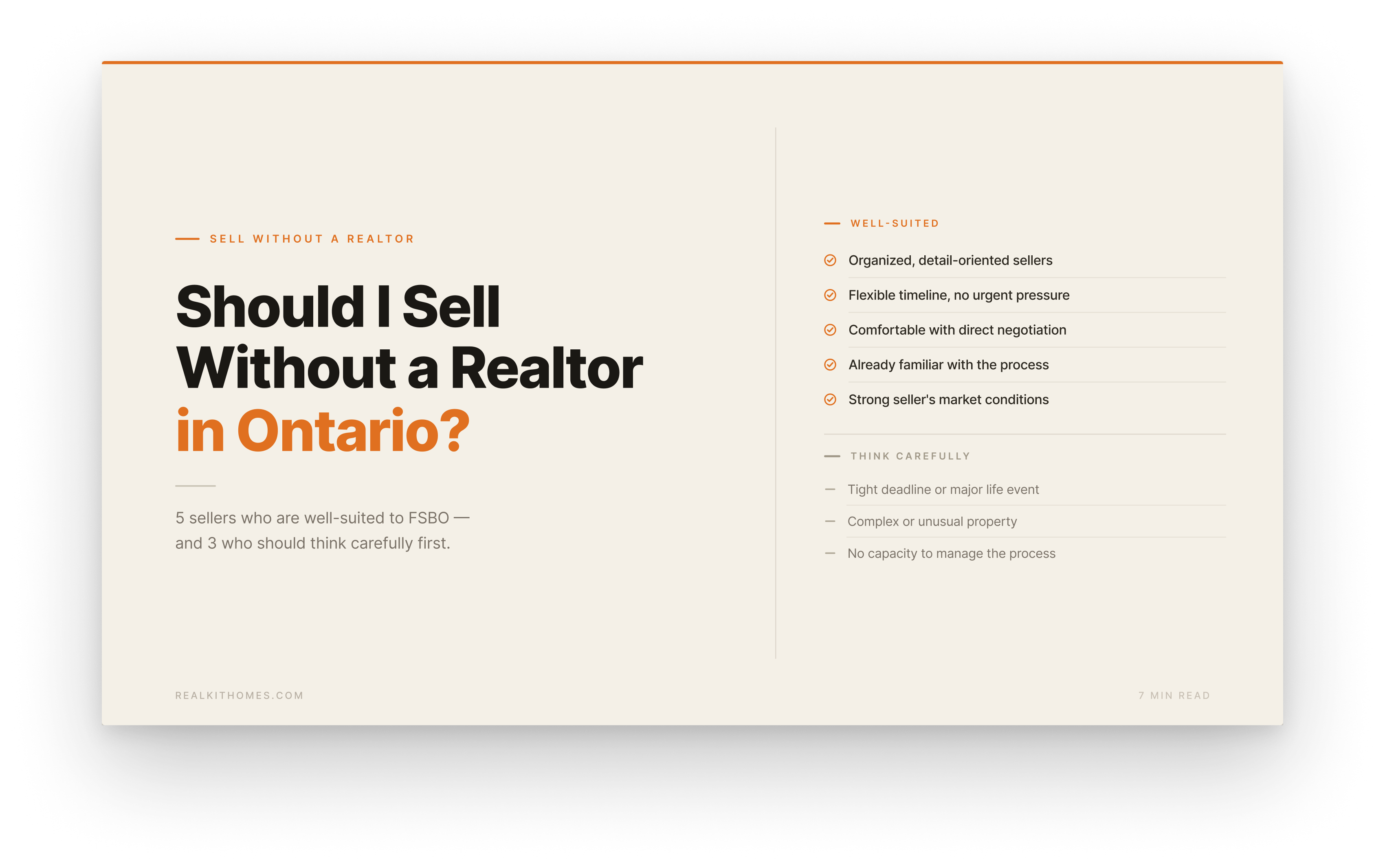
- Five Ontario homeowners who should consider selling privately
- Three homeowners who should think carefully before choosing FSBO
- A practical way to decide
- Where Realkit fits into a private sale
- Frequently Asked Questions
- Conclusion
- Sources
3.The right question to ask before choosing FSBO
The question is not simply, “Can I sell my house without a Realtor?”
In Ontario, you can sell privately. You can work directly with buyers, arrange showings, receive offers, and have your real estate lawyer handle the legal work and closing.
A better question is:
“Can I handle the parts of the sale that a listing agent normally manages without losing more in time, stress, price, or mistakes than I save in commission?”
A private sale normally puts you in charge of:
- Pricing and positioning the property
- Creating the listing and sharing it where buyers can find it
- Answering inquiries and screening people before showings
- Keeping the home ready for viewings
- Following up with interested buyers
- Deciding how to work with buyer agents
- Organizing offers, counter-offers, documents, conditions, and deadlines
- Bringing your lawyer in before you commit to a deal
For many sellers, this is manageable. For others, it becomes overwhelming at exactly the wrong point, often when a serious offer arrives.
4.Five Ontario Homeowners Who Should Consider Selling Privately
1. The organized homeowner with time to manage the sale
Private selling is often a strong fit for a homeowner who is naturally organized and has enough room in their schedule to respond to buyers.
You do not need to be available every minute of the day. But you do need to be able to respond reasonably quickly, book showings without creating confusion, and keep track of each conversation.
This can be a good fit if you are someone who already:
- Uses calendars and reminders consistently
- Is comfortable keeping documents organized
- Can answer messages during the day or after work
- Is willing to prepare the home for several showings in a week
- Does not mind following up with interested buyers
For example, imagine a homeowner in Milton selling a well-maintained three-bedroom detached home. They work from home two days a week, their children are older, and they can arrange weekday-evening or Saturday showings. They have renovation invoices, tax information, and appliance details saved in folders already. That homeowner may be well positioned for FSBO.
The day-to-day workload is real, but it does not have to be chaotic if you have the time and a process.
Sellers who want a realistic preview of the work involved can see how private selling changes your regular routine in what FSBO really looks like day-to-day.
2. The seller with a straightforward, easy-to-understand property
Some homes are easier to sell privately than others.
A conventional home in a recognizable neighbourhood is usually easier for buyers to understand and compare. Think of a clean, well-kept townhouse in Barrie, a semi-detached home in Oshawa, or a family detached home in Kitchener with a familiar layout and clear recent upgrades.
A straightforward property often has:
- A standard residential use
- Clear parking arrangements
- No major known structural or environmental concerns
- A familiar layout and property type
- Easy access for buyers and inspectors
- Documents that are reasonably easy to gather
This does not mean the home has to be perfect. It means there are fewer unusual moving pieces to explain.
A buyer can more easily compare your home with recent nearby sales, understand its strengths, and decide whether it fits their needs. That makes it easier to price, market, show, and negotiate directly.
Before listing, gather the key paperwork buyers are likely to ask for, such as property tax information, utility details, renovation records, warranties, and, where relevant, condo documents.
3. The seller in a high-demand local market who can price realistically
A desirable location can make private selling easier, but only if you stay realistic about the price.
If your home is in an area where buyers are actively searching, such as a family-friendly GTA suburb near transit, a growing Ontario city, or a neighbourhood with limited inventory for your property type, you may have a stronger chance of attracting direct interest.
However, demand does not fix an unrealistic asking price.
A seller in a desirable neighbourhood can still lose momentum by listing too high because:
- Buyers may not request a showing
- Buyer agents may steer clients toward better-value options
- The listing can sit long enough that buyers start asking what is wrong with it
- The seller may eventually have to reduce the price after losing the strongest early interest
A good private-sale candidate in a high-demand area is someone who can look at the market honestly. They are willing to compare their home with nearby alternatives, account for condition and location differences, and adjust if buyer feedback points to a problem.
If timing matters, understand the difference between preparation time, days on market, condition periods, and closing. A private sale can move quickly, but only when the price, access, and buyer communication are working together.
4. The homeowner who already knows their likely buyer
Some Ontario homeowners already have a natural buyer pool before they list.
This could include:
- A neighbour who wants to move family onto the street
- A tenant interested in purchasing the property
- A friend or colleague who has been watching for a home in the area
- A buyer who attended a previous private viewing
- Someone in a local community group who has asked about the home
This does not mean you should skip proper paperwork or rush into a deal. A familiar buyer can still need financing, inspections, legal review, and a formal Agreement of Purchase and Sale.
But a known or highly interested buyer can make the marketing phase simpler because you may not need to create broad exposure before learning whether there is a real deal to be made.
For example, if a neighbour in Guelph has been looking for a home for their parents and already knows your street, they may understand the location, parking, schools, and local amenities before they ever step inside. That can make early conversations more productive.
Even in a direct sale, involve your lawyer before you agree to terms or sign an offer. Familiarity does not remove the need for a properly structured transaction.
5. The seller who wants control but is willing to work with professionals
The best private sellers are not necessarily people who want to do everything alone.
They are people who want control over the sale while still using the right professionals at the right time.
That usually means:
- You decide how your home is presented
- You decide when buyers can view it
- You decide which offer and closing date work for you
- Your lawyer handles legal documents, title matters, and closing
- A mortgage professional may be involved if you need to understand your own mortgage payout or break penalty
- Your buyer may have an agent, broker, lender, and inspector involved on their side
This approach is particularly practical for homeowners who want to save the listing-side commission but do not want to guess their way through an offer or closing.
A private sale is not a DIY legal transaction. Your lawyer should review serious offers before you sign, explain the terms you are agreeing to, and manage the legal closing process.
If a buyer has an agent, you can still sell privately while deciding whether to offer cooperating commission, how showings will work, and how communication should be handled.
5.Three Homeowners Who Should Think Carefully Before Choosing FSBO
1. The seller with a complex property or a complicated situation
Some homes are not impossible to sell privately, but they require more preparation and professional support.
You should think carefully about FSBO if your property involves:
- A tenant or multiple tenants
- A rural property with a well, septic system, acreage, or right-of-way concerns
- A heritage designation
- A shared driveway or unusual easement
- A major renovation with uncertain permit history
- A recent flood, water issue, foundation issue, or other significant known concern
- A condo corporation with unusual financial, reserve-fund, or special-assessment issues
- An estate sale, separation, or multiple owners who need to agree on decisions
The issue is not that private selling is unavailable. The issue is that each added complication can create more questions from buyers, inspectors, lenders, and lawyers.
For example, selling a Toronto condo privately might look simple at first, but a buyer may need time to review the status certificate, financial statements, reserve fund, rules, recent meeting minutes, and any special assessment information. A seller who does not have those documents ready can lose momentum or create delays.
If your situation is complex, speak with a real estate lawyer early. You may still choose FSBO, but you should make that decision with a clear view of the extra work and risk.
2. The seller who needs a firm sale quickly and cannot absorb a failed deal
If you need to sell by a specific date because you have already bought another home, are relocating for work, or have a tight financial deadline, private selling may feel riskier.
The risk is not simply that FSBO takes longer. A good private sale can move quickly. The risk is that a private seller may have less room to recover if:
- The property receives too little exposure
- A buyer’s financing falls through
- A condition is not fulfilled
- A buyer backs away during negotiations
- An offer has a closing date that does not align with your next move
- The seller is not ready for a quick inspection, appraisal, or lawyer request
If you are carrying two mortgages, paying bridge financing, or must close on a certain date, do not make the decision based on commission alone. Map out your timeline and understand what happens if your first buyer does not close.
A direct cash offer or a flat-fee MLS approach may be worth considering in some situations, depending on whether you prioritize speed, open-market exposure, or a simpler process.
3. The seller who dislikes negotiation, conflict, or constant communication
Private selling requires you to have direct conversations that some people would rather avoid.
You may need to respond when a buyer says:
- “We love it, but your price is too high.”
- “Our agent says the basement needs work.”
- “We want an inspection condition and a longer financing period.”
- “We will offer this amount only if you include the appliances.”
- “Can we move the closing date?”
There is nothing wrong with not wanting those conversations. Selling a home is personal, and it can be difficult to separate emotional attachment from a business decision.
FSBO may not be the right fit if you know that you will:
- Take low offers personally
- Avoid following up with buyers because it feels uncomfortable
- Feel pressured to accept the first offer just to get the process over with
- Struggle to say no when a buyer or buyer agent pushes for concessions
- Find it stressful to have strangers entering your home
An organized system can make the process much easier, but it cannot remove the need to make decisions and communicate directly. In that case, consider whether a full-service listing, flat-fee MLS service, or another selling path better fits your temperament.
6.A Practical Way to Decide
Before choosing your sale method, answer these five questions honestly.
Do I have time to manage the sale?
You should have enough time to:
- Reply to inquiries
- Schedule showings
- Keep the home reasonably ready
- Follow up after viewings
- Review offers with your lawyer
- Track deadlines during conditions and closing
If your answer is “only on Sunday evenings,” full FSBO may not be the easiest fit.
Is my property easy for buyers to understand?
Think about whether your home has a standard story or whether it needs a lot of explanation.
A typical freehold home with clear upgrades is simpler than a rural property, a tenanted investment property, or a condo with issues buyers may need to investigate.
Can I price without using wishful thinking?
You should be comfortable making decisions based on recent comparable sales, current competition, condition, location, and buyer feedback.
A private sale works best when you can separate your emotional attachment to the home from what the market is likely to support.
Am I comfortable with buyer agents?
Many serious Ontario buyers will have an agent. Decide in advance how you will handle:
- Showing requests from agents
- Cooperating commission
- Offers delivered through an agent
- Negotiations where the agent is working for the buyer
You do not need to become an expert negotiator overnight, but you should have a plan before the first agent calls.
Do I have a lawyer ready before offers arrive?
You do not need to hire a lawyer to take listing photos or respond to your first inquiry. But you should know who you will call before serious offers arrive.
Your lawyer should review the Agreement of Purchase and Sale and any amendments before you commit. They can explain the terms, point out issues you should consider, and handle the legal process once the sale moves toward closing.
7.Where Realkit Fits Into a Private Sale
For many homeowners, the biggest problem with FSBO is not the idea of selling privately. It is keeping the moving pieces organized once the listing is live.
A private seller can quickly end up with:
- Buyer questions in texts, email, Facebook Messenger, and phone calls
- Showing times in a personal calendar
- Feedback written on loose notes
- Documents in several folders
- Offer versions spread across email threads
- Condition dates that are easy to miss
Realkit gives the sale one workspace.
You can use it to keep buyer conversations, showing requests, property documents, offer activity, and key milestones organized in one place. It does not replace your lawyer, tell you what price to accept, or provide legal advice. It helps you run the operational side of the sale in a clearer and more professional way.
That is particularly useful for the homeowners who are good candidates for FSBO: people who want control, but do not want their sale managed through scattered messages and memory alone.
9.Conclusion
The right private seller is not necessarily the person who knows the most about real estate. It is the person whose home, timeline, confidence, and capacity fit the work involved.
FSBO can be a strong choice for an organized seller with a straightforward home, a realistic price, enough time to manage buyers, and the willingness to bring in a lawyer for the legal work. It can be a tougher choice when the property or situation is complicated, the timeline is rigid, or direct negotiations would create too much pressure.
Make the decision based on the full picture: your likely net proceeds, time, stress, exposure, and ability to stay organized. If you choose to sell privately, treat it like a real transaction from day one, not an experiment with a lawn sign.
10.Sources
- Real Estate Council of Ontario, consumer guidance on representation, buyer and seller relationships, and the role of registered real estate professionals in Ontario transactions.
- Insight Law Firm, “How to Sell a House Privately in Ontario,” covering private-sale paperwork, lawyer involvement, buyer agents, offers, and closing considerations.
- Filipe Sells, “How to Sell Your Home Without a Real Estate Agent in Ontario,” covering the practical pricing, marketing, offer, and coordination work taken on by FSBO sellers.
- Noble Real Estate, “The Real Risks of For Sale By Owner in Ontario,” discussing risks around disclosure, legal documents, and private-sale preparation.
- GTA West Living, “2 Key Risks When Selling a Home Privately in Ontario,” discussing homeowner safety, pricing, buyer access, and disclosure considerations.
- Realkit resources on selling privately, managing documents, working with buyer agents, FSBO timelines, and avoiding common private-sale mistakes.