1.Introduction
When a buyer sees your Ontario home listed for sale, they are not asking only, “Do I like this house?”
They are also asking, “Does this price make sense compared with everything else I could buy?”
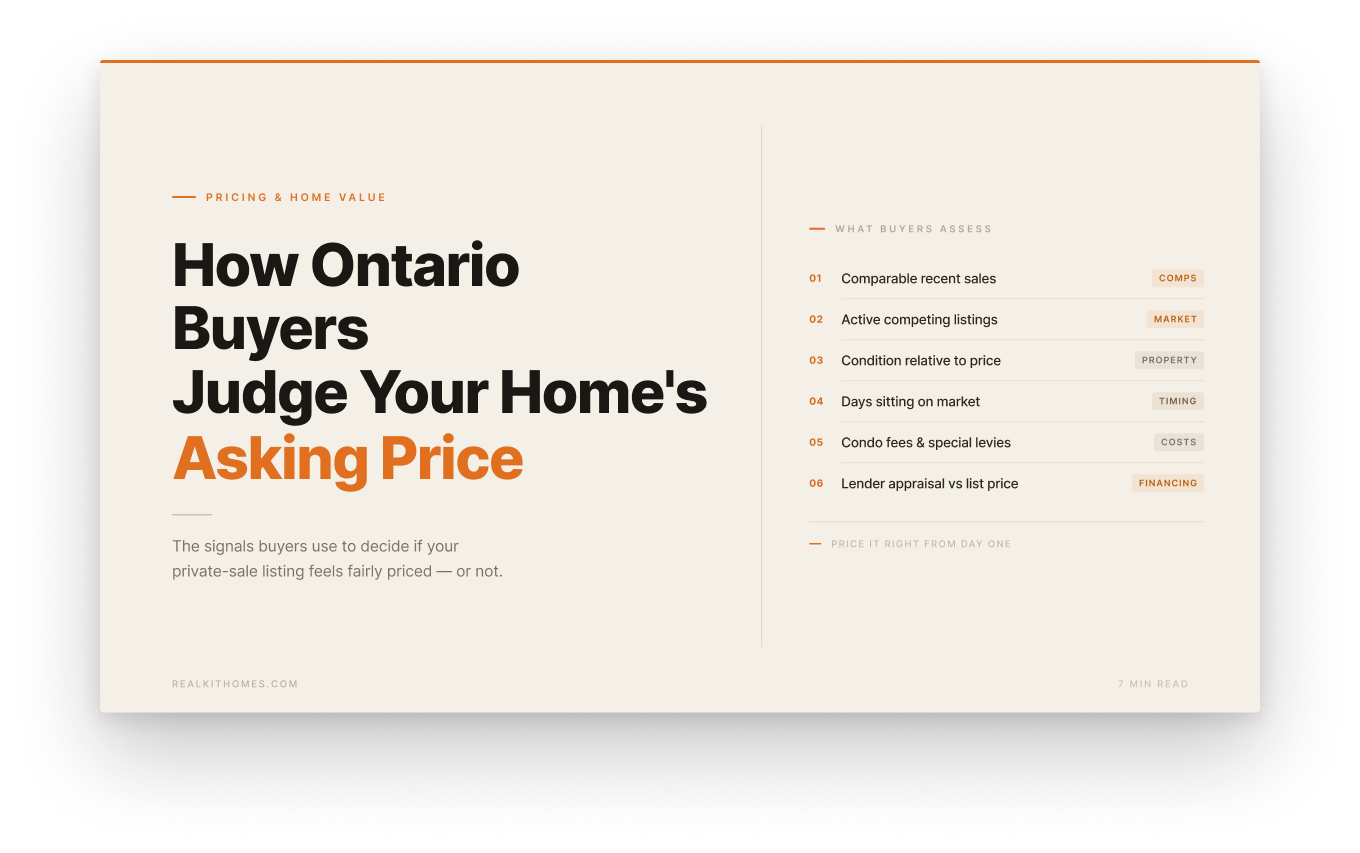
That judgement happens quickly. Buyers compare your home with recent sales, active listings, the homes they saw last weekend, what their lender says they can afford, and what their own agent has told them about the local market. They notice the obvious details, such as updated kitchens and parking, but they also notice less obvious ones, such as condo fees, a busy road, basement usability, the age of major systems, and the length of time a listing has been on the market.
For private sellers, this matters because a buyer does not give extra value simply because you are selling without a Realtor. Some buyers may expect part of any potential commission savings to show up in the purchase price. Others may be cautious if your listing information is incomplete or if your asking price seems disconnected from nearby alternatives.
The goal is not to find one perfect number. It is to understand how buyers make their decision, then present and price your home in a way that holds up when they compare it with real alternatives.
2.Table of Contents
- How buyers decide whether your price feels fair
- The three comparisons buyers make first
- What makes a listing feel overpriced
- Why buyers do not value every upgrade equally
- How location changes a buyer’s price judgement
- Condo fees, parking, and monthly carrying costs
- How financing affects what buyers can offer
- What buyer agents are likely to compare
- The impact of days on market and price changes
- Using feedback without chasing every opinion
- How to prepare a stronger pricing case
- How Realkit helps private sellers stay organized
- Frequently Asked Questions
- Conclusion
- Sources
3.How Buyers Decide Whether Your Price Feels Fair
Buyers rarely evaluate a home from scratch. Most arrive with a reference point.
That reference point might be:
- A home they viewed recently
- A comparable property that sold nearby
- A price range from their lender or mortgage broker
- A list of options sent by their buyer agent
- Their own sense of what homes in the neighbourhood “should” cost
The buyer is usually not deciding whether your home is worth your asking price in the abstract. They are deciding whether it is better, worse, or roughly equal to the homes they can buy for similar money.
This is why a home can be well priced on paper but still struggle. If buyers can see two stronger alternatives at a similar price, your listing may feel expensive even if it is close to a recent sale.
Buyers judge value through trade-offs
Most buyers accept that no home is perfect. They are looking for trade-offs they can live with.
A buyer may pay more for:
- A more convenient location
- Better parking
- A larger or more functional lot
- A renovated kitchen or bathroom
- A finished basement
- A move-in-ready home
- Lower condo fees
- A better floor, view, or layout in a condo building
- Less immediate maintenance work
At the same time, buyers may expect a lower price if the home needs work, has limited parking, sits on a busy road, has a challenging layout, carries high monthly costs, or requires compromises that competing homes do not.
Your job as a private seller is not to convince buyers that drawbacks do not exist. It is to price and present the home so its strengths and trade-offs make sense together.
4.The Three Comparisons Buyers Make First
Recent sold homes
Buyers often start with recent sales. These give them an idea of what other people were willing to pay for homes that may be similar.
But buyers and buyer agents do not simply search for the highest sale in a broad neighbourhood. They look for similarities such as:
- Property type
- Number of bedrooms and bathrooms
- Lot size or unit size
- Condition and renovations
- Parking
- Basement finish
- Location within the neighbourhood
- Building, floor, exposure, and fees for condos
- Sale date
A detached home that sold three months ago after a complete renovation may not support the same price for a similar-sized home that still needs a kitchen, bathrooms, flooring, and roof work.
Current active listings
Sold homes tell buyers what happened in the past. Active listings tell them what they can choose right now.
This is often where sellers make mistakes.
If your home is listed at $900,000 and buyers can tour two similar homes at the same price with better finishes, more parking, or a larger lot, they may not care that a stronger home sold for $900,000 several months ago. Their practical choice is between the homes available today.
Before listing, look closely at the homes buyers will see beside yours:
- What is listed in your likely price range?
- Which homes are newer, cleaner, larger, or better located?
- Which homes have already reduced their price?
- Is there a lower-priced home that buyers may view as a better deal?
- Are you competing with a different property type that appeals to the same buyer?
Their own monthly budget
Many buyers think in monthly payments, not only purchase price.
A buyer may compare:
- Mortgage payment
- Property taxes
- Condo fees
- Utility costs
- Insurance
- Parking or storage costs
- Expected repairs after closing
This is especially important for Ontario condos and townhouses. Two homes with similar asking prices can have very different monthly carrying costs. A buyer may pay more upfront for a home with lower monthly fees, better parking, or fewer anticipated repairs.
5.What Makes a Listing Feel Overpriced
A buyer does not need to know the exact market value of your home to feel that the asking price is too high. They simply need to see a better option nearby.
Common signals that make a private-sale listing feel overpriced include:
- Asking more than recent comparable sales without a clear reason
- Pricing close to homes with significantly better renovations
- Ignoring a busy road, irregular lot, limited parking, or awkward layout
- Using outdated sales while current competition has changed
- Leaving out condo fees or key property details until late in the process
- Listing high without a clear plan for buyer interest or negotiation
- Refusing to revisit price after repeated consistent feedback
Overpricing does not always mean the property will never sell. It can mean fewer showings, more low offers, a longer listing period, and a reduced ability to negotiate from a strong position later.
Buyers often pay closest attention during the first days and weeks a listing is available. If the price turns away the most motivated early buyers, a later reduction may not recreate the same level of interest.
A price reduction does not erase the listing history
When buyers notice a price reduction, they often ask why it happened.
Sometimes the answer is simple: the seller adjusted to the market. That is not automatically a problem.
But repeated reductions can create questions:
- Was the home initially priced based on emotion rather than evidence?
- Has something been found during previous inspections?
- Did earlier buyers walk away?
- Is the seller under pressure to move?
You do not need to disclose your personal situation to buyers. But you do need a pricing strategy before you list, so you are not forced into reactive changes without understanding what feedback is actually telling you.
6.Why Buyers Do Not Value Every Upgrade Equally
Sellers often attach value to work they paid for. Buyers see upgrades differently.
A buyer may appreciate a new roof, furnace, electrical panel, or waterproofing work because it reduces uncertainty. But they may not pay dollar-for-dollar for it because they see it as expected maintenance rather than a lifestyle upgrade.
On the other hand, a clean, bright kitchen, updated main bathroom, functional laundry area, and fresh paint may have an outsized impact on buyer perception because they affect what the buyer sees immediately.
Improvements that support buyer confidence
Buyers often respond well when a seller can clearly explain:
- What was updated
- When it was completed
- Who completed it, where relevant
- Whether permits, warranties, receipts, or manuals are available
- How the work improved the home’s function or condition
For example, “Roof replaced in 2023, invoice available” gives a buyer a clearer signal than “newer roof.”
Keep records organized before listing. They can support your asking price, reduce uncertainty, and make it easier to answer buyer questions consistently.
Improvements that may not recover their full cost
Not every improvement translates into the same added value.
Highly personal finishes, expensive landscaping, niche built-ins, and premium materials may matter to some buyers but not others. A buyer may admire a renovation while still choosing another home with better parking, a more useful layout, or a more convenient location.
Price your home based on what competing buyers are likely to value, not only what you spent.
7.How Location Changes a Buyer’s Price Judgement
In Ontario, location is more detailed than the city name or postal code.
Buyers often notice differences such as:
- Quiet crescent versus busy arterial road
- Corner lot versus interior lot
- Walkability to transit, schools, parks, and shopping
- Distance to a GO station or major highway
- Road noise, rail lines, commercial uses, or construction nearby
- Access to parking
- School boundaries and commute practicality
- Ravine, water, green space, or other outlook considerations
A home may be only a few blocks from a recent comparable sale but appeal to a different buyer because of road position, lot shape, noise, or access.
Be clear rather than evasive
If your home is near a transit line, commercial area, busy road, or other feature buyers will notice, avoid trying to hide it through selective photos or vague descriptions.
A better approach is to give the home’s strengths proper context. For example, a buyer may accept a busier location if the home offers better transit access, a larger lot, updated condition, or a lower price than quieter alternatives.
The buyer will discover the trade-off during a showing. Your listing and price should already account for it.
8.Condo Fees, Parking, and Monthly Carrying Costs
For Ontario condo sellers, the asking price is only part of the buyer’s calculation.
Buyers may look at:
- Monthly condominium fees
- What those fees include
- Parking and locker ownership
- Visitor parking
- Building amenities
- Reserve fund information
- Building age and maintenance history
- Special assessments or known major work
- Rules that affect pets, rentals, renovations, or moving
A condo with a lower asking price can still feel expensive if its monthly fees are significantly higher than similar units. A unit with parking and a locker may feel stronger than a slightly cheaper unit without either.
Make condo information easy to understand
Your listing should clearly state the monthly condominium fee and what is included, where you have reliable information.
Have key building details ready before a buyer asks. If a serious buyer requests a status certificate, speak with your lawyer about the proper process and any transaction-specific questions.
Buyers may make a condo offer conditional on reviewing the status certificate. A seller who prepares early is less likely to lose momentum while trying to find documents after an offer arrives.
9.How Financing Affects What Buyers Can Offer
A buyer may love your home and still be limited by financing.
Their lender may consider:
- Purchase price
- Down payment
- Income and debt obligations
- Property taxes
- Condo fees
- Appraised value
- Property condition or marketability concerns
- Whether the buyer is also selling another home
This is why the strongest offer is not always the highest price.
A buyer offering more may need a larger mortgage, a longer financing condition, or a lender appraisal that supports the agreed price. Another buyer with a slightly lower offer but stronger financing and fewer conditions may be more likely to close smoothly.
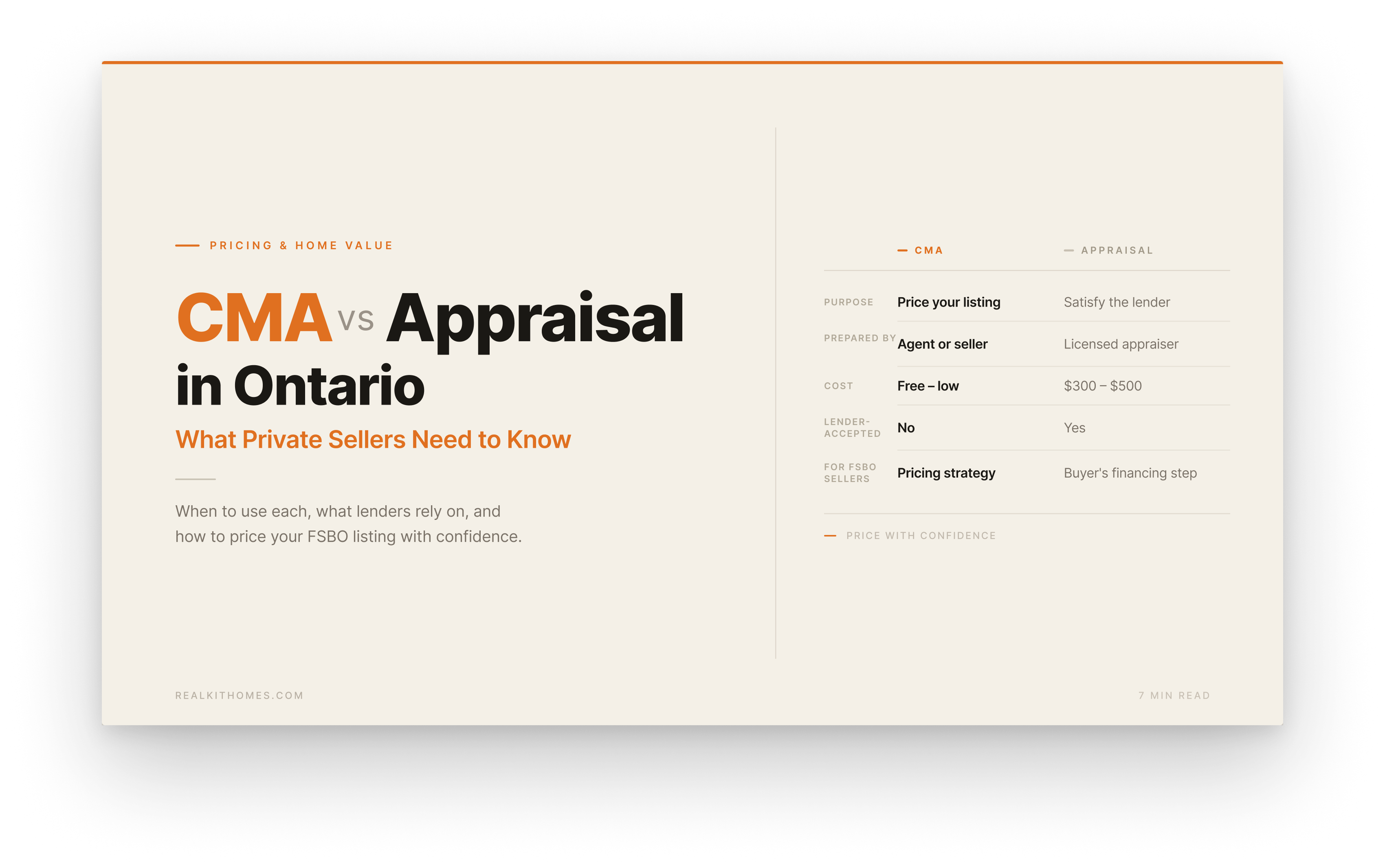
Buyer financing and lender appraisals
If a buyer is financing their purchase, their lender may require an appraisal. The appraiser’s opinion can affect the amount the lender is prepared to advance.
If an appraisal comes in lower than the agreed purchase price, the buyer may need more cash, a different financing arrangement, or a renegotiation. The result depends on the purchase agreement, the buyer’s financing, and the decisions of everyone involved.
Do not assume you must automatically reduce your price. Speak with your lawyer before agreeing to a change in price or terms.
10.What Buyer Agents Are Likely to Compare
A buyer agent is working for the buyer. Their role includes helping that buyer assess value, structure an offer, and negotiate terms.
When an agent views your private-sale home, they may compare it with:
- Similar homes currently listed
- Recent sales in the immediate area
- Listings that failed to sell
- Homes with better or weaker upgrades
- Price-per-square-foot figures for condos, used carefully
- Parking, lot, and location differences
- Condo fees and building considerations
- Days on market and price history
They may also ask direct questions about why you set the asking price where you did.
That does not mean you need to defend every number. It means you should have a calm, evidence-based explanation of your pricing and know which features you believe support it.
Private sellers who understand how buyer agents operate are less likely to be caught off guard in a pricing conversation.
11.The Impact of Days on Market and Price Changes
Days on market can change how buyers see your listing.
A newly listed home can feel like an opportunity. A listing that has remained available for a long period may lead buyers to wonder whether the property is overpriced, difficult to finance, hard to show, or affected by an issue they have not yet identified.
That does not mean every longer listing has a problem. Some homes appeal to a narrow buyer pool, have a higher price point, or need time because of their unique features.
The practical issue is how you respond when activity is weaker than expected.
Review the right signals
After your listing has been active long enough to generate meaningful feedback, look at:
- Number of inquiries
- Showing requests
- Showings completed
- Repeated buyer comments
- Whether people praise the home but say the price is too high
- Which competing homes are selling
- Whether buyers are asking the same unanswered questions
- Whether access, photos, or listing accuracy are limiting interest
Do not change your price because of one person’s opinion. Do pay attention when several serious buyers, buyer agents, or showing patterns point to the same concern.
Price is not always the problem
Sometimes the price is reasonable, but the listing is underperforming because of:
- Weak photography
- Incomplete property details
- Limited showing availability
- Slow replies to inquiries
- Missing condo information
- Confusing inclusions or exclusions
- A description that fails to explain a useful feature
Before reducing the asking price, check whether the buyer experience is making the home harder to understand.
12.Using Buyer Feedback Without Chasing Every Opinion
Buyer feedback can help, but it needs context.
A comment such as “too expensive” may mean:
- The buyer cannot afford the home
- The buyer prefers a different neighbourhood
- The buyer is trying to negotiate
- The buyer has seen a stronger alternative
- The listing genuinely feels out of step with the market
The key is to identify patterns.
Track feedback in a useful way
After each showing, record:
- What the buyer liked
- What they questioned
- Whether they mentioned price
- Which competing property they referred to
- Whether they asked for documents or a second visit
- Whether they were represented by an agent
- Whether they indicated a likely offer timeline
For example, if five separate buyers say the kitchen needs work, that does not automatically mean you should renovate mid-listing. It may mean your price should reflect the condition, or that your listing should be compared against homes with a similar level of finish.
Realkit can help you keep showings, buyer messages, property documents, feedback, and offer activity in one place. That makes it easier to see patterns before making a pricing decision.
13.How to Prepare a Stronger Pricing Case
You do not need to become a professional appraiser to explain your asking price well. You do need a clear file that supports your reasoning.
Before listing, prepare:
- A list of recent comparable sales
- Notes on current active competition
- A record of meaningful differences between your home and each comparable
- Details of recent upgrades and repairs
- Property tax and utility information
- Condo fee and building information, if relevant
- A list of inclusions and exclusions
- Invoices, permits, warranties, or manuals where available
- Notes on neighbourhood or property features that buyers may value
An illustrative example
This example is illustrative only.
Imagine you are selling a three-bedroom Ontario townhouse with a garage and finished basement. A buyer agent says a nearby townhouse sold for less, so your asking price is too high.
You review the sale and find that the other townhouse had no garage, an unfinished basement, older windows, and a monthly fee that was lower than yours. You also compare your home against a current listing with a similar garage and basement, but stronger kitchen finishes.
A reasonable response is not to dismiss the agent’s sale or insist your home is superior. It is to acknowledge the comparison, explain the differences, and decide whether your asking price still fits the full group of competing homes.
That is the kind of disciplined pricing conversation buyers expect.
14.How Realkit Helps Private Sellers Stay Organized
A pricing decision does not end when your listing goes live.
You may need to review new competition, track buyer feedback, provide documents, compare offers, and revisit your approach if interest is weaker than expected. That becomes difficult when messages are spread across text, email, social media, and personal notes.
Realkit helps private sellers keep their listing details, showings, buyer communication, documents, offers, counteroffers, and transaction milestones organized in one workspace.
For example, if several buyers raise the same question about condo fees, parking, basement use, or recent upgrades, you can see the pattern and respond consistently. If an offer arrives, you can keep the offer version, counteroffer, deadlines, and related documents organized before speaking with your lawyer.
Realkit does not provide legal advice, determine your home’s value, guarantee a sale, or guarantee buyer financing. It helps make the operational side of a private sale easier to manage.
16.Conclusion
Buyers judge your asking price by comparison.
They compare your home with recent sales, active listings, their monthly budget, nearby alternatives, and the compromises they would need to make. They are not only looking at square footage or bedroom count. They are deciding whether your home offers enough value for the price, given its condition, location, parking, fees, upgrades, and timing.
For an Ontario private seller, the best response is preparation. Build a realistic pricing file, look honestly at active competition, make key property information easy to find, track buyer feedback, and review serious offers with your lawyer.
A price that makes sense to buyers is not always the highest possible number on listing day. It is the number that helps the right buyers understand why your home is worth considering over the alternatives.
17.Sources
- Appraisal Institute of Canada: Residential Property Owners
- Appraisal Institute of Canada: Mortgage Professionals
- Toronto Regional Real Estate Board: Market Watch
- Toronto Regional Real Estate Board: Market Data
- Condominium Authority of Ontario: Status Certificates
- Government of Ontario: Land Transfer Tax
- RE/MAX Canada: Home Appraisal vs Current Market Assessment
- Metrix Realty: Appraisal vs Realtor CMA, What Is the Difference in Ontario?