1.Introduction
If you are an Ontario homeowner who wants to avoid a full listing commission, you do not have to choose between “hire a Realtor” and “do everything yourself with a sign and a phone.”
In Ontario today, there are three main ways to sell without a traditional listing Realtor:
- Full FSBO, where you run the sale yourself.
- Flat‑fee MLS or “mere posting” services, where your home appears on REALTOR.ca but you still manage showings and offers.
- Direct cash buyers, where you skip public listing completely and trade price for speed and simplicity.
Each path has different trade‑offs for price, effort, and risk.
This guide compares those options in plain language, with Ontario‑specific context.
By the end, you should have a clear sense of which approach, or combination of approaches, fits your situation and where a tool like Realkit can help you stay organized once interest starts coming in.
2.Table of Contents
- What “selling without a traditional Realtor” actually means
- Option 1: Full FSBO (For Sale By Owner) in Ontario
- Option 2: Flat‑Fee MLS and mere postings
- Option 3: Direct cash buyers and investor offers
- Comparing the three options on money, effort, and control
- How timelines differ between FSBO, flat‑fee, and cash sales
- Where lawyers, lenders, and inspectors fit in each option
- How Realkit can support any of these private paths
- Frequently Asked Questions
- Sources
3.What “selling without a traditional Realtor” actually means
You are skipping full‑service listing representation
When you decide to sell without a traditional Realtor, you are mainly choosing not to hire a listing agent who:
- Prices and markets your home
- Manages showings and communication
- Guides offer negotiations
- Coordinates with other professionals
You are not skipping lawyers, lenders, or closing. Those are still there.
You are choosing how much of the coordination and marketing you want to handle yourself and how much exposure you want through MLS and other channels.
You still need to think about buyers and buyer agents
Most serious buyers in Ontario are working with agents, watching MLS listings, and comparing options in your city or neighbourhood. That matters even when you decide to sell privately.
The paths in this guide show different ways to reach those buyers or bypass them, but they all need to end with a solid Agreement of Purchase and Sale, proper closing, and clear communication.
4.Option 1: Full FSBO (For Sale By Owner) in Ontario
What full FSBO looks like
Full FSBO means you:
- Create and publish your own listing on platforms that allow private sellers.
- Take and upload photos.
- Answer all buyer messages yourself.
- Schedule and host showings.
- Review and negotiate offers.
- Coordinate with your lawyer once the deal is serious.
You are replacing the listing agent’s coordination role. You are not replacing your lawyer’s role in closing.
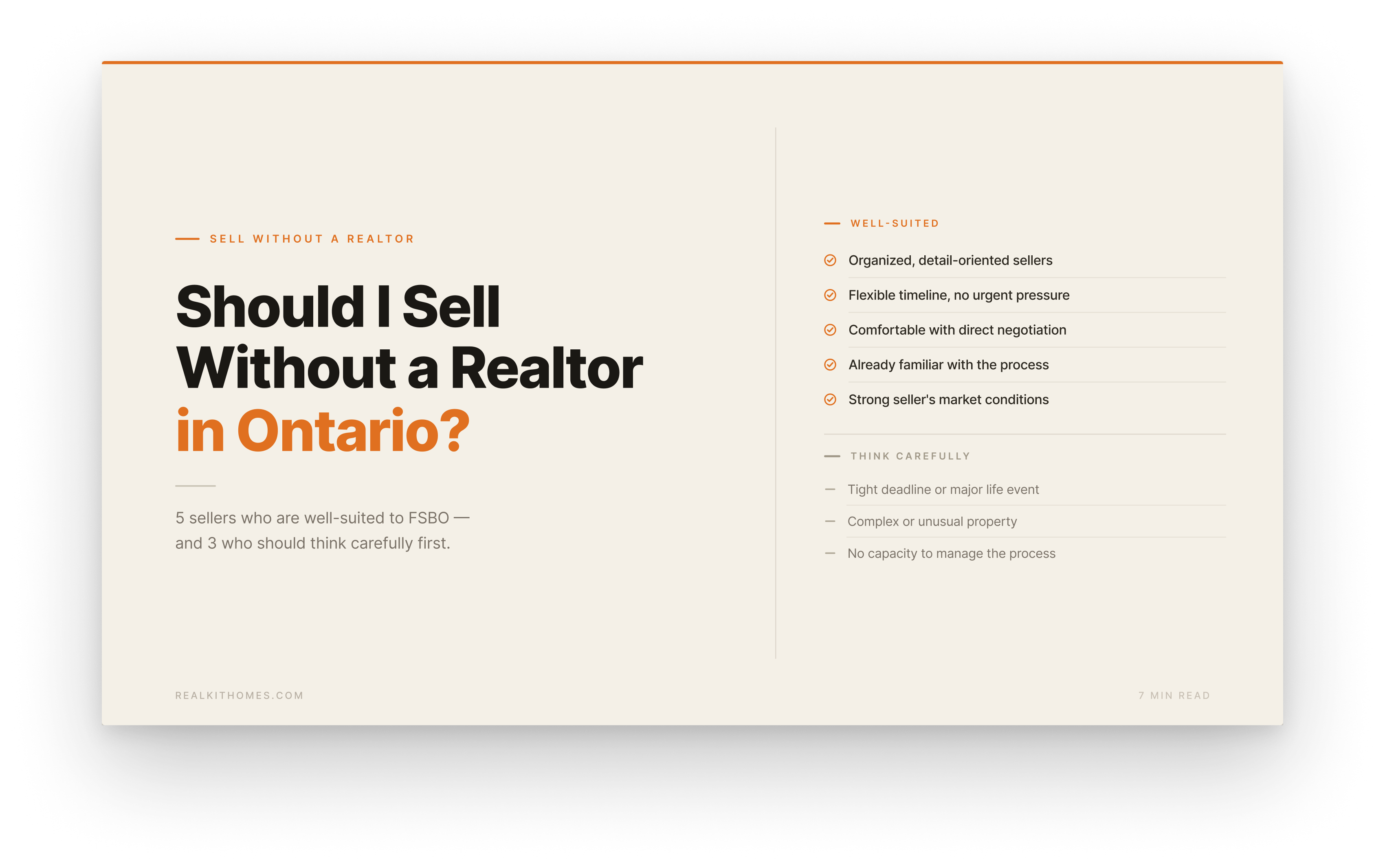
Where full FSBO works well
Full FSBO tends to work best when:
- Your property is fairly straightforward.
- You are realistic about pricing.
- You are comfortable communicating with buyers directly.
- You have enough time to manage showings and follow‑up.
- You are ready to involve a lawyer once offers arrive.
If you have already read about the pros and cons of selling without an agent, you know that full FSBO can save listing‑side commission but adds more work to your daily life.
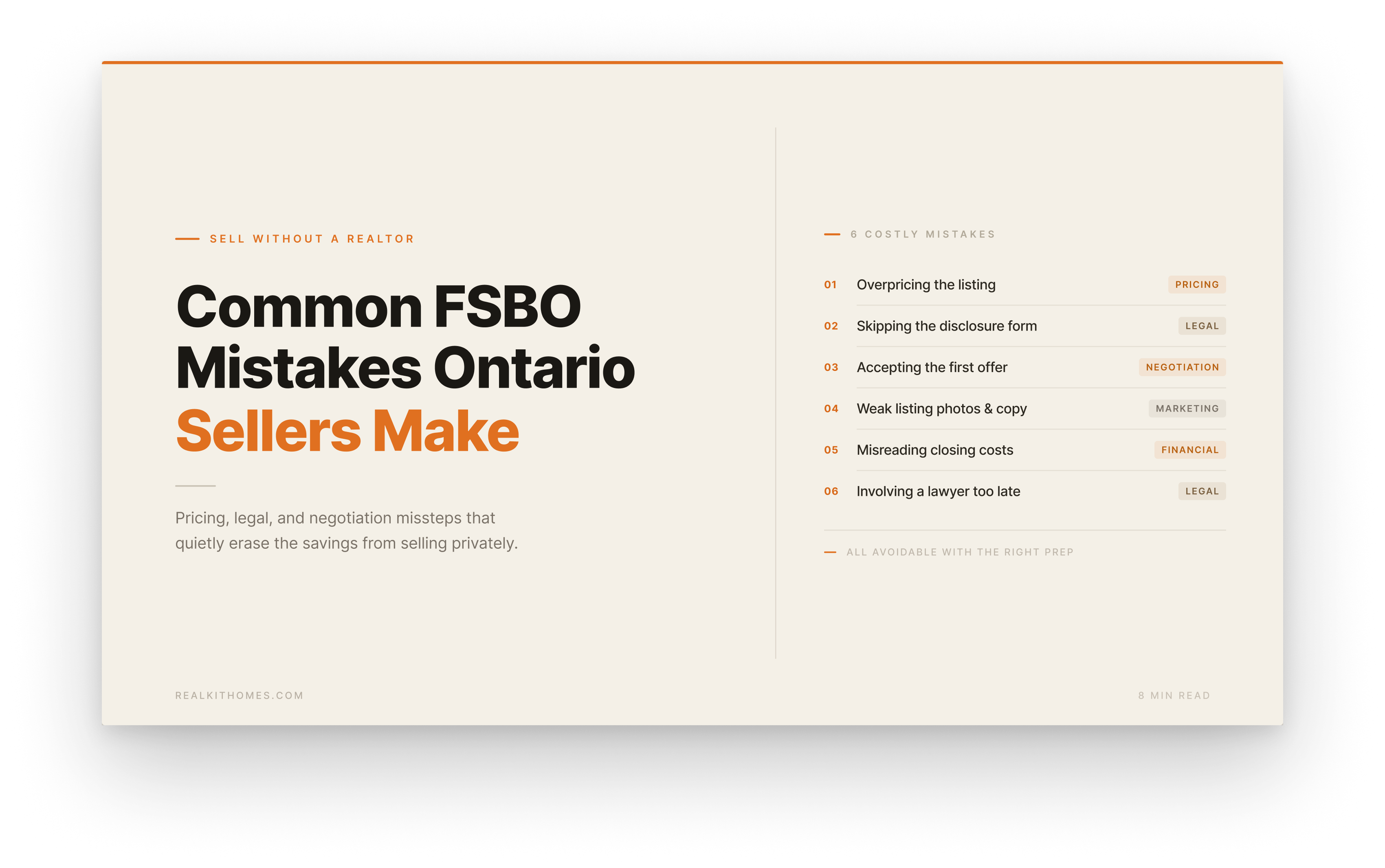
Common FSBO challenges
Ontario FSBO sellers often run into:
- Underestimating the time needed to respond quickly.
- Overpricing based on emotion or one strong comparable.
- Weak listing photos compared with MLS properties.
- Disorganized offer handling when more than one buyer is interested.
This is where having a clear plan, and a way to keep showings, messages, and offers in one place, becomes important.
5.Option 2: Flat‑Fee MLS and mere postings
What flat‑fee MLS services do
Flat‑fee MLS services, including well‑known FSBO and mere posting providers, let you:
- Pay a set fee to have your property entered into the local MLS system.
- Appear on REALTOR.ca and other syndicated sites.
- Reach a larger pool of buyers and buyer agents.
The key point is that these services are usually “mere postings.” The brokerage posts your listing but does not act as your full‑service listing agent. You still manage much of the coordination yourself.
Your responsibilities with flat‑fee MLS
With flat‑fee MLS, you typically:
- Provide the listing information and photos to the service.
- Decide your asking price.
- Take calls and emails from buyers and buyer agents.
- Manage showings and follow‑up.
- Handle offer discussions, often with your lawyer’s help.
You get MLS exposure without full listing representation.
Why flat‑fee can be a good middle ground
Flat‑fee MLS can suit Ontario sellers who:
- Want broad exposure but prefer not to pay full listing commission.
- Are comfortable coordinating showings and basic communication.
- Are ready to work with buyer agents and lawyers directly.
It can shorten the “time on market” phase if your listing stands out and your pricing is realistic, because buyers and agents see your home alongside other MLS properties in their search feeds.
6.Option 3: Direct cash buyers and investor offers
What direct cash buyers offer
Direct cash buyers and investor groups, including some Ontario home‑buying companies, offer to:
- Purchase your property quickly, often without listing it publicly.
- Reduce or remove the need for traditional showings.
- Close on dates that fit your urgency.
The trade‑off is that they are usually looking for a discount from full market value in exchange for speed and convenience.
When a cash buyer might make sense
Direct cash buyers may be worth considering if:
- You need to sell very quickly because of life changes.
- Your property needs more work than typical buyers want.
- You want to avoid open market showings completely.
- You are willing to accept less than full market value for certainty and simplicity.
It is still important to get legal advice and understand what you are agreeing to, even in a cash sale.
What you still need to do
Even with a cash buyer, you will need to:
- Review the offer carefully.
- Work with a lawyer for closing and title transfer.
- Confirm any conditions, inspections, or access needs.
The closing process is still a legal transaction. Your lawyer and the buyer’s lawyer will handle the formal paperwork and funds.
7.Comparing the three options on money, effort, and control
Money
In simple terms:
- Full FSBO: You avoid listing‑side commission and may choose whether to offer buyer‑side commission. Exposure may be narrower if you do not use MLS.
- Flat‑fee MLS: You pay a smaller fixed fee instead of full listing commission, but may still offer buyer‑side commission. You get MLS reach.
- Direct cash buyers: You likely accept a lower sale price but pay little or no commission, and you trade some potential upside for speed.
Your net outcome depends on price, costs, and the specific deal details.
Effort
Effort levels look like:
- Full FSBO: Highest coordination workload. You are doing most of the marketing, messaging, showings, and offer handling.
- Flat‑fee MLS: Moderate workload. MLS helps attract more eyes, but you still manage showings and core communication.
- Direct cash buyers: Lowest coordination workload. Fewer showings and simpler negotiation, but you still handle legal steps and logistics.
If you have already seen what FSBO looks like day‑to‑day, you know how much work full FSBO can involve when interest builds.
Control
Control is highest in:
- Full FSBO and flat‑fee MLS, where you decide how to present the home, how to respond, and when to accept or reject offers.
- Direct cash buyers give control over speed and closing date, but less control over price because they are offering based on their investment model.
8.How timelines differ between FSBO, flat‑fee, and cash sales
FSBO timelines
With full FSBO:
- Prep might take one to three weeks.
- Time on market can range from a couple of weeks to several, depending on exposure and pricing.
- Closing periods are still usually 30–90 days once the deal is firm.
Flat‑fee MLS timelines
Flat‑fee MLS can:
- Shorten the “time on market” phase if your listing performs well among MLS properties.
- Still require similar prep and closing periods.
Buyers and agents see your listing faster when it is on REALTOR.ca and syndicated sites, which can help if time matters.
Cash buyer timelines
Direct cash buyers often move faster:
- Negotiation and acceptance can happen within days or weeks.
- Closing might be set on a shorter timeline, depending on the buyer’s process and your situation.
You should still plan for a realistic closing window so lawyers and lenders can do their work properly, even if inspections are limited and financing is simpler.
9.Where lawyers, lenders, and inspectors fit in each option
Lawyers
In every path:
- A real estate lawyer is central to closing.
- They review or prepare the Agreement of Purchase and Sale.
- They handle title, Statement of Adjustments, and closing documents.
Whether you go full FSBO, flat‑fee MLS, or cash, involving your lawyer when offers are serious is essential.
Lenders and mortgage brokers
If your buyer is using financing:
- Their lender and broker become important once an offer is accepted.
- They may require an appraisal and specific documents.
- Financing conditions affect your timeline and risk.
Flat‑fee MLS and FSBO expose you more to typical financed buyers. Cash buyers may bring fewer financing conditions but still need a clean path to closing.
Inspectors
Inspectors may:
- Carry out home inspections under a condition clause.
- Provide reports that could lead to renegotiation.
Inspection is common in traditional and flat‑fee MLS sales, and less common, but still possible, in cash deals. You should be prepared for inspection access, especially in full FSBO or flat‑fee scenarios.
10.How Realkit can support any of these private paths
No matter which option you choose, the coordination work increases as soon as real interest starts.
Realkit helps by:
- Giving you a central workspace to track showing requests and confirm times.
- Keeping buyer and agent conversations tied to your listing rather than scattered across apps.
- Storing offers, counter‑offers, and APS versions in one place.
- Showing transaction milestones clearly as lawyers and mortgage professionals move the deal forward.
If you are doing full FSBO or using flat‑fee MLS, Realkit acts like the “file room” for your private sale, making it easier to handle the extra tasks you have taken on yourself.
12.Conclusion
Selling without a traditional listing Realtor in Ontario is not a single decision. It is a choice between different ways of going to market:
- Full FSBO: maximum control and potential savings, with more work and coordination.
- Flat‑fee MLS: broad exposure with lower listing costs, but you still run the sale day‑to‑day.
- Direct cash buyers: faster and simpler, often at a lower price.
The right path for you depends on how quickly you need to sell, how comfortable you are with managing showings and negotiation, and how much you value open market exposure versus simplicity.
No matter which route you choose, lawyers, lenders, and inspectors still play their roles, and you still need a clear way to keep communication and documents under control. That is where a coordination tool like Realkit can make any private sale feel more like a well‑run file and less like a pile of texts and emails.
13.Sources
- ForSaleByOwner.ca – “Our Selling Process” and “How it Works,” explaining flat‑fee MLS, mere postings, and how private sellers use REALTOR.ca and syndication to reach buyers.
- Insight Law Firm – “Selling Your Home Privately in Ontario: The Complete FSBO Guide,” outlining FSBO roles, legal requirements, and buyer‑side commission expectations in Ontario.
- GTA House Buyers – “How to Sell a House Privately in Ontario,” discussing private sale steps and scenarios where cash sales and investor offers can be simpler for some sellers.
- Axess Law, JoinNest, and NiagaraHomes – Ontario FSBO and paperwork guides covering APS, closing steps, risks, and what private sellers must understand before choosing their path.
- FSBO and MLS‑alternative platforms and Ontario real estate blogs describing FSBO mistakes, pricing and marketing impact on timelines, and comparisons between full service, flat‑fee, and private sale options.