1.Introduction
If you are planning to sell your home privately in Ontario, you are likely focused on your own side of the sale. You are thinking about how to price, how to handle showings, and how to manage offers without a listing agent.
There is another reality you need to plan for: many serious buyers in Ontario are already working with their own agents.
When those buyer agents call or email you about your FSBO listing, you want to be prepared. You need to understand how cooperating commission works, what their role is, what rights you have as a private seller, and how to handle offers and communication without feeling pushed around or exposed.
This guide explains how to work with buyer agents in a private sale. It is written for Ontario homeowners who want to save on listing‑side commission but still deal fairly and confidently with represented buyers.
2.Table of Contents
- Why buyer agents show up in private sales
- What a buyer agent actually does in Ontario
- Cooperating commission: your options as a private seller
- How to talk about commission with buyer agents
- How buyer representation agreements affect your sale
- Handling showings when the buyer has an agent
- Receiving and reviewing offers through buyer agents
- Where your lawyer fits in when an agent is involved
- How to stay organized when multiple agents are in the mix
- How Realkit helps keep agent‑involved FSBO deals manageable
- Frequently Asked Questions
- Sources
3.Why buyer agents show up in private sales
Most serious buyers in Ontario are not flying solo
In Ontario’s current framework, many buyers sign a buyer representation agreement with an agent and brokerage.
That agent then helps them:
- Search for suitable properties
- Arrange showings
- Evaluate pricing and market value
- Prepare and submit offers
- Navigate conditions and closing steps
Even if you decide to sell without a listing agent, those buyers are still out there. Their agents are paid through commission when a deal closes. When those buyers see your private listing, their agent will often contact you on their behalf.
FSBO does not mean “no agents at all”
Selling privately means you are not using a listing agent to represent you. It does not mean that no agents will be involved.
In a real‑world Ontario FSBO sale, you can easily have:
- You as an unrepresented seller
- One or more buyers represented by their own agents
- Lawyers on both sides handling legal and closing work
Your choice is not “agents or no agents.” It is “no listing agent for your side, and then decide how you want to handle buyer agents as they appear.”
4.What a buyer agent actually does in Ontario
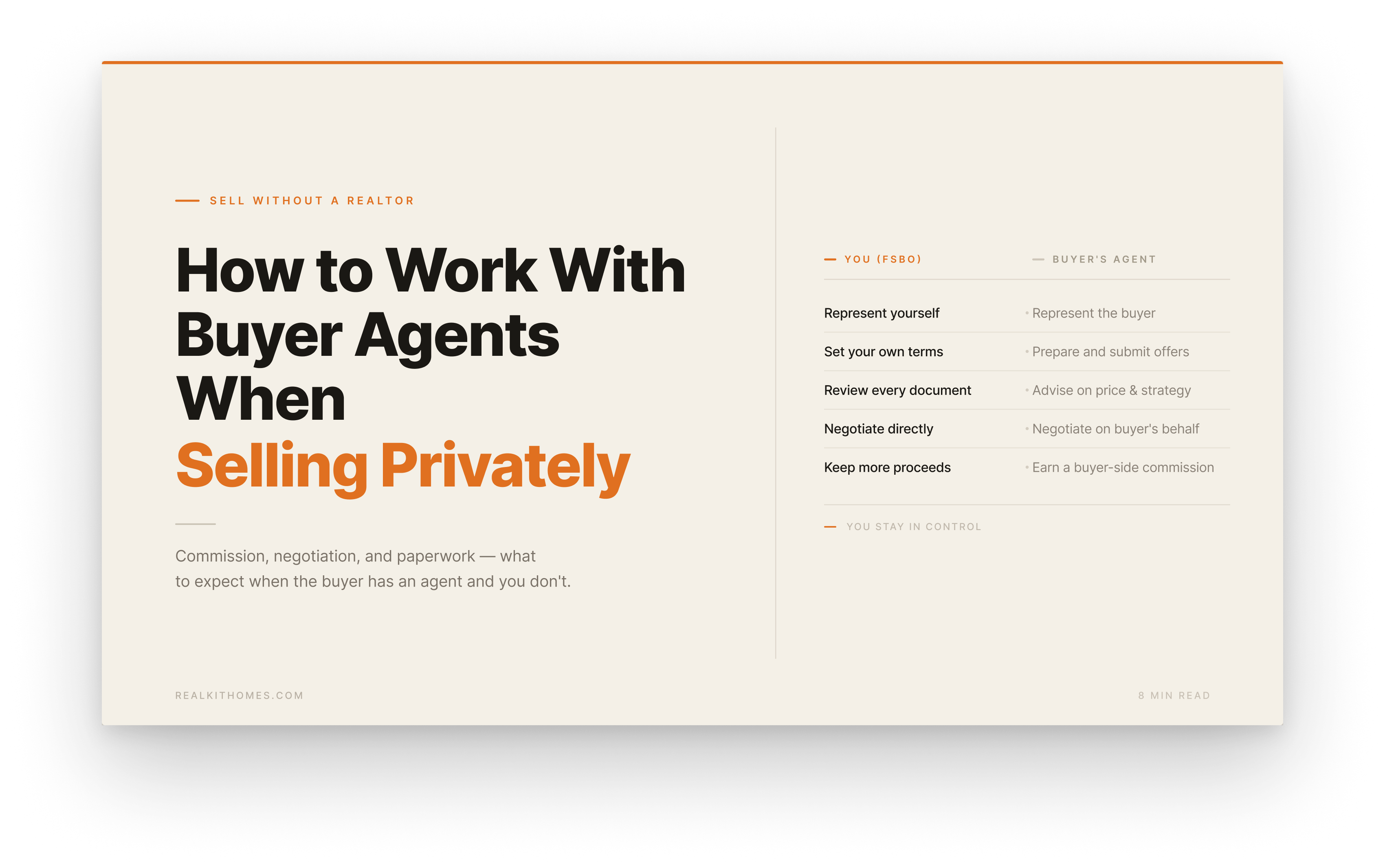
Their job is to look out for the buyer
A buyer agent in Ontario owes duties to their client. They focus on:
- Helping the buyer understand market value
- Highlighting risks they see in the property or deal
- Structuring the offer to protect the buyer
- Negotiating price and conditions with you
They are not there to protect you as the seller. That is your job, supported by your lawyer.
They are used to dealing with listing agents
Most of the time, buyer agents deal with listing agents, not directly with sellers.
They are used to:
- Calling or messaging another agent for showings
- Reviewing MLS notes for details and disclosures
- Negotiating through another professional
In a private sale, they will be dealing directly with you instead. That is fine, but it can feel unusual for them and for you. Setting expectations early helps.
5.Cooperating commission: your options as a private seller
You can choose whether to offer commission to buyer agents
When an agent represents a buyer, they expect to be paid if their client successfully purchases your home. In a typical Ontario listing, the seller agrees to pay both listing and buyer‑side commission out of their sale proceeds.
In a private sale, you decide:
- Whether to offer buyer‑side commission
- How much you are prepared to offer
- Whether you want to focus entirely on unrepresented buyers
Common cooperating commission levels in Ontario often sit around 2% to 2.5% of the sale price for the buyer’s agent side, plus HST, but it is negotiable.
Why some private sellers still offer buyer‑side commission
Offering a cooperating commission can:
- Make your listing more attractive to buyers who are already working with agents
- Encourage agents to show your property rather than skip it because their client would have to pay their fee out of pocket
- Help you tap into a larger pool of serious, mortgage‑ready buyers
If you have read about the net savings of FSBO versus Realtor, you know that it may still be worthwhile to offer a buyer‑side commission while avoiding listing‑side commission.
What if you do not want to offer commission?
You are not obligated to pay a buyer agent’s commission.
If you choose not to:
- Some agents will still show the property but will expect their client to pay them directly.
- Some buyers will see this as an extra cash cost and may be less motivated.
- Some agents will avoid the listing entirely, depending on how their business is set up.
This can reduce the number of showings from represented buyers. You may decide that this trade‑off is acceptable if your main goal is to keep costs as low as possible.
6.How to talk about commission with buyer agents
Decide your position before you list
It is much easier to handle commission discussions if you decide your stance before your listing goes live.
Think through:
- Are you comfortable offering a buyer‑side commission?
- If yes, what percentage and whether that includes HST or not.
- If no, are you prepared to explain that clearly and stick to it?
Having this clarity will help when the first agent calls and asks, “What is your cooperating commission?”
Keep the conversation simple and factual
When an agent asks about commission, you can keep your answer short and straightforward.
For example:
- “We are selling privately and we are offering X% plus HST to buyer agents.”
- Or: “We are selling privately and focusing on buyers who are comfortable with their own arrangements. We are not offering a cooperating commission at this time.”
Whatever you choose, avoid getting defensive. Treat it like any other term in the deal.
7.How buyer representation agreements affect your sale
Buyer representation agreements exist between buyer and agent
In Ontario, buyer representation agreements set out the relationship between the buyer, the agent, and the brokerage. They cover:
- The area the agent will work in
- The time period of representation
- How the agent will be compensated
- Duties and expectations on both sides
As a private seller, you are not a party to that agreement, but it affects how the buyer’s agent looks at your listing.
Why buyers may care about your commission stance
If the buyer’s agreement says their agent is to be paid a certain way, and your private sale does not offer cooperating commission, then:
- The buyer might have to pay their agent directly.
- The buyer’s total cash outlay increases.
- The buyer may use that as a reason to push harder on price.
Understanding this helps you see why some represented buyers are very focused on commission and why some are less interested in private listings where no cooperating commission is offered.
8.Handling showings when the buyer has an agent
Scheduling through the agent
When a buyer has an agent, most showing coordination will come through that agent, not directly from the buyer.
Your day might include:
- Answering calls or texts from different agents asking for viewing times.
- Confirming dates and time windows.
- Making sure access is clear (lockbox, present owner, etc.).
FSBO showing tips often focus on dealing with buyers directly, but in Ontario it is common for a large portion of showings to be agent‑led.
Being clear about rules and expectations
Before an agent arrives with their client, make sure you are clear on:
- Whether you will be home or away during the showing.
- Any areas that are off‑limits.
- How long they can stay.
- Whether they are bringing multiple people.
You can treat agent‑led showings much like any other viewing, but it helps to present your expectations professionally. It sets the tone for later offer discussions.
9.Receiving and reviewing offers through buyer agents
Expect offers to arrive professionally written
When a buyer’s agent prepares an offer, it will usually be:
- Based on standard Ontario Agreement of Purchase and Sale forms.
- Structured with clear price, deposit, conditions, closing date, and chattels/fixtures.
That can be helpful. It reduces the risk of major omissions.
Remember who the agent is working for
Even though the paperwork might look organized, remember:
- The agent is representing the buyer.
- They are trying to get good terms for their client.
- They may use market data and negotiation tactics in discussions with you.
Your role is to assess whether the offer works for you. This is a key moment to involve your lawyer so they can review the APS and advise you on legal and practical implications.
Negotiating through the agent
Negotiation with a buyer’s agent can involve:
- Price discussions
- Changing deposit amounts
- Adjusting conditions and timelines
- Tweaking closing dates to fit your plans
It is normal for the agent to push, but you do not have to accept terms you are not comfortable with. Make sure you:
- Take time to think.
- Ask your lawyer about any clauses you do not understand.
- Consider both price and structure, not just the headline number.
10.Where your lawyer fits in when an agent is involved
Your lawyer is your professional support
When buyer agents are involved, your lawyer becomes even more important.
They help by:
- Reviewing offers prepared on standard Ontario forms.
- Explaining what the clauses mean in plain language.
- Highlighting risks or unusual conditions.
- Handling all the legal steps once a deal is accepted.
In a private sale, you do not have a listing agent to buffer the legal side. Your lawyer is your main professional safeguard, whether the offer comes from an agent or directly from a buyer.
When to bring your lawyer into the conversation
You should plan to:
- Contact your lawyer as soon as a serious agent‑prepared offer arrives.
- Ask them to review the Agreement of Purchase and Sale.
- Get their input before you sign or commit to changes.
They will not tell you what price to accept, but they will give you clarity on what each clause and timeline means, which lets you negotiate more confidently.
11.How to stay organized when multiple agents are in the mix
Keep a simple record of agent contacts
Once your FSBO listing is visible, it is common to have several agents reach out. Without a system, it becomes hard to remember who is who.
You can avoid confusion by noting:
- Agent name and brokerage
- Buyer’s basic profile (family, investor, downsizer, etc.)
- Dates of showings and any feedback they gave
- Whether they mentioned potential offers or interest
This matters especially if you end up with more than one offer and want to compare not just numbers but how serious each buyer seems.
Track offers and changes carefully
When offers, counter‑offers, and amendments start moving around, disorganization can cost you time and leverage.
Instead of letting these documents sit in separate email threads, it is smarter to:
- Keep each version labelled and stored together.
- Note which changes were made and when.
- Make sure your lawyer sees the final agreed terms.
Realkit can help here by acting as a single workspace where:
- Each agent‑led buyer conversation is attached to the listing.
- Offers and counter‑offers are stored in one place.
- You, your lawyer, and any other professionals can see the file without digging through your inbox.
12.How Realkit helps keep agent‑involved FSBO deals manageable
Realkit is not a brokerage and not a law firm. It does not replace representation or legal advice. It is a coordination tool that helps you handle the operational side of a private sale, including cases where buyer agents are involved.
In a deal with one or more buyer agents, Realkit can:
- Keep all showing requests and confirmations in a structured calendar rather than scattered messages.
- Tie each buyer and agent to a shared conversation thread, so you see who said what and when.
- Store and organize offers, counter‑offers, and key documents in one workspace.
- Show a simple progress timeline for conditions and closing steps.
The more moving parts you have, the more valuable this kind of structure becomes. It lets you act like the point person for your own sale without needing to invent your own tracking system.
14.Conclusion
Selling privately in Ontario does not mean you will never deal with real estate agents. It often means you will deal with them differently.
Most serious buyers have agents. Those agents will call about showings, bring offers, and negotiate on their clients’ behalf. Your job as a private seller is to decide how you want to handle cooperating commission, stay clear about your expectations, and involve your lawyer at the right moments so the legal side is solid.
With a bit of planning and a structured way to keep track of conversations and documents, working with buyer agents does not have to be a source of stress. It can simply be another part of how you manage your sale, with you remaining in control of your decisions.
15.Sources
- Insight Law Firm – “Selling Your Home Privately in Ontario: The Complete FSBO Guide,” explaining buyer agent expectations and cooperating commission ranges in Ontario private sales.
- JoinNest – “What Private Sellers Need to Know About Ontario Real Estate Law,” outlining TRESA, APS, SPIS, closing costs, and cooperating commission options for private sellers.
- RECO (Real Estate Council of Ontario) – consumer resources on working with real estate agents, representation agreements, and how agent relationships are structured.
- NiagaraHomes, Axess Law, and other Ontario FSBO and paperwork guides explaining private sale risks, paperwork, and how buyer agents interact with private listings.
- Ontario agent blogs and FSBO content covering practical tips for selling privately, common buyer agent dynamics, and mistakes that cost FSBO sellers money.