1.Introduction
One of the first questions Ontario homeowners ask when they think about selling privately is not “Can I do FSBO?” It is “What paperwork do I actually need to make this work?”
You might be comfortable showing your home and talking to buyers, but the idea of missing an important document or messing up something legal can be stressful. The good news is that you do not have to become a lawyer to sell privately in Ontario, but you do need to understand what documents matter, when they come into play, and who is responsible for each part.
This guide walks you through the key documents involved in a private home sale from listing to closing. It focuses on practical, Ontario-specific details so you can gather what you need, know where your lawyer steps in, and keep everything organized throughout the process.
2.Table of Contents
- Listing and marketing information
- Disclosure and property information
- The Agreement of Purchase and Sale (APS)
- Offer-related documents and conditions
- Lawyer and closing documents
- Extra paperwork for condos and special situations
- How Realkit helps keep your documents organized
- Frequently Asked Questions
- Sources
3.Listing and marketing information
Before you think about formal legal documents, you need the basic information that will go into your listing and the early conversations with buyers.
Core property details
As a private seller in Ontario, you will want to gather:
- Legal address and lot description or condo unit details
- Number of bedrooms and bathrooms
- Type of property (detached, semi, townhouse, condo, etc.)
- Square footage or approximate size
- Parking details (garage, driveway, underground, visitor)
- Basement details (finished, unfinished, separate entrance)
- Property tax amount from your latest bill
- Condo fees and what they include, if applicable
- Age of the home or year built
- Recent upgrades (roof, windows, furnace, kitchen, bathroom) and approximate dates
These details go into your listing, but they also act as a checklist. If you cannot answer basic questions about taxes, fees, or parking, serious buyers may wonder what else is unclear.
Photos and description
While photos and descriptions are not “documents” in the legal sense, they are important parts of your FSBO file.
In Ontario’s competitive markets, buyers expect:
- Clear, bright photos of the main rooms, exterior, and key features
- An honest description in plain language
- Accurate details about the neighbourhood, nearby transit, and schools
Think of your listing as the front page of your private sale file. If it looks sloppy, buyers assume the rest of the process will be sloppy too.
4.Disclosure and property information
Ontario homeowners are expected to be honest about known issues with their property. The exact forms you use can vary, but the principle is the same: do not hide important problems.
Known issues and repairs
You should be ready to talk about:
- Any history of water leaks or flooding
- Foundation cracks or shifting
- Roof issues and when they were repaired
- Electrical or plumbing problems that were fixed
- Work done without permits
- Easements, encroachments, or shared driveways
You do not need to turn this into a legal document on your own, but you should have your notes ready. If there are complex issues, that is a sign to bring your lawyer into the conversation when offers start.
Seller property information statements and similar forms
Some Ontario transactions use a formal Seller Property Information Statement or similar disclosure-type forms. In a private sale, whether you use one is something you can discuss with your lawyer. The key is that any formal document you do sign should be handled with care, because it may be relied on by the buyer later.
Helpful documents for buyer confidence
Even if they are not strictly required, certain documents can help buyers feel more comfortable:
- Recent utility bills to show typical costs
- Property tax receipts
- Renovation contracts or invoices for major work
- Transferable warranties on things like windows, roof, or appliances
- Any recent inspection reports
Canada’s federal guidance for sellers specifically mentions deeds, survey plans, tax receipts, renovation contracts, warranties, and inspection reports as helpful documents for buyers. In Ontario, having these ready can make your private sale feel more professional and reduce friction later.
5.The Agreement of Purchase and Sale (APS)
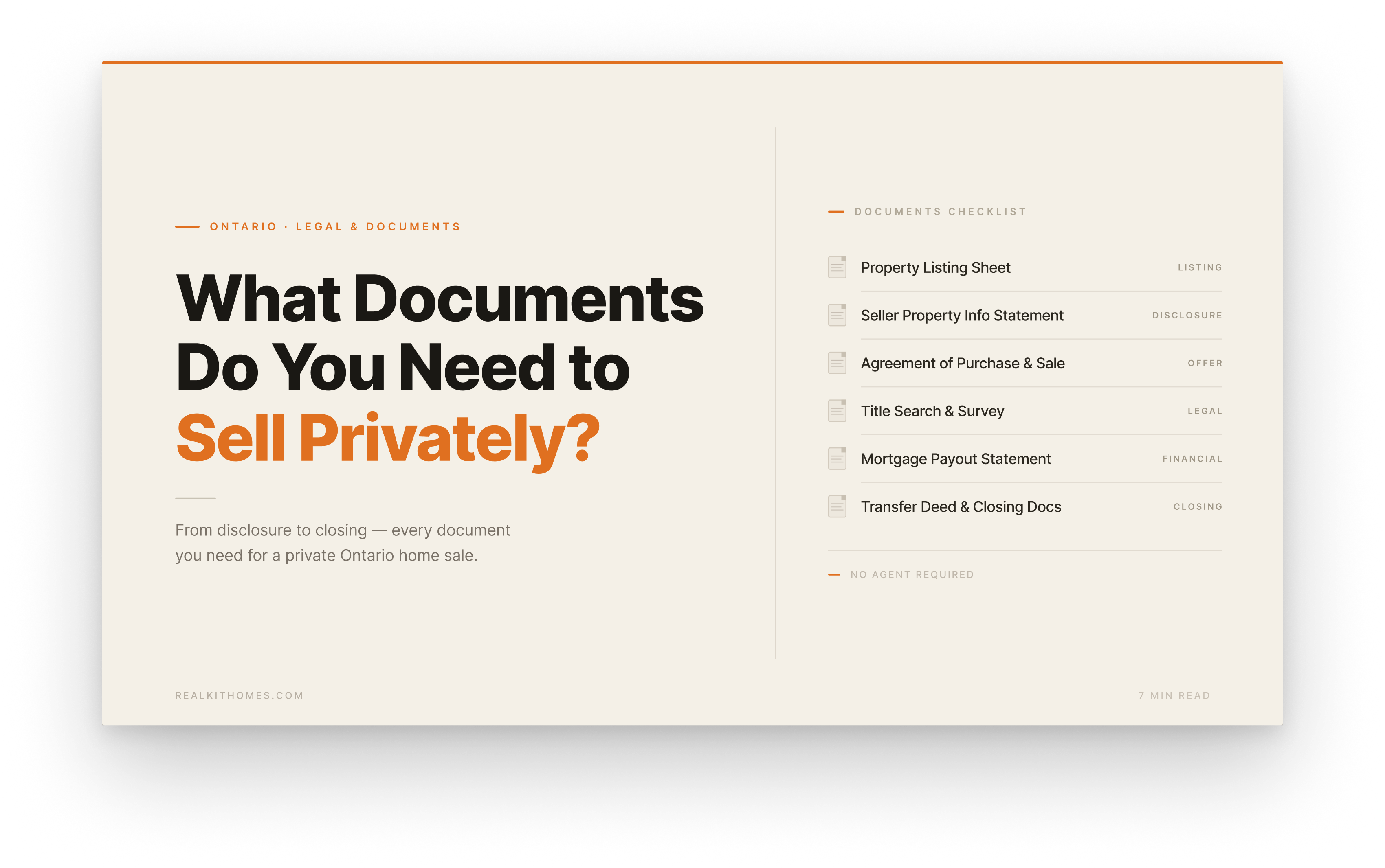
The single most important document in a private home sale in Ontario is the Agreement of Purchase and Sale. This is the written contract that sets out the price, deposit, conditions, closing date, and other terms.
What the APS does
The APS:
- Records the agreed purchase price
- Sets how much deposit is paid and when
- Includes the closing date
- Lists any conditions (financing, inspection, sale of buyer’s property, condo status, etc.)
- Specifies what is included or excluded (appliances, light fixtures, window coverings, etc.)
- Contains clauses covering default, adjustments, and other legal matters
In Ontario, standard APS templates are widely used, including forms created for the brokerage world. In a private sale, your lawyer is the person who should help you ensure the APS is appropriate for your situation and properly completed.
Who should draft or review the APS in a private sale
As a private seller, you should not be trying to create your own APS template from scratch or relying on generic documents found online.
Your lawyer is the right person to:
- Draft an APS suited to a private sale, or
- Review an offer prepared by the buyer’s side and make sure it protects you properly
When an offer gets serious, this is one of the key moments where you should consult your lawyer. They will focus on the legal content and structure. Your job is to be clear on what you are comfortable agreeing to and what you want to negotiate.
Sellers who have already read through what happens when they sell without an agent will be familiar with how this step fits into the broader decision between FSBO and traditional listings.
7.Lawyer and closing documents
Once your deal moves toward closing, your lawyer handles much of the paperwork. You still benefit from understanding what is happening.
Title search and related paperwork
Your lawyer will run a title search to confirm:
- You have good title to the property
- There are no unexpected liens
- Easements and restrictions are properly noted
They may also deal with any issues identified in that search. This is usually documented through requisitions and responses on title matters.
Statement of Adjustments
Near closing, your lawyer prepares a Statement of Adjustments.
This document:
- Shows the agreed purchase price
- Accounts for property tax and utility adjustments
- Reflects deposit credits
- Calculates the final amount due from the buyer
It is one of the key closing documents that helps ensure both sides know exactly what is being paid and why.
Mortgage discharge and payout documents
If you have a mortgage on the property, your lawyer and lender will coordinate:
- A mortgage payout statement from your lender
- Discharge documentation to remove the mortgage from title
- Any prepayment penalty details if you are breaking your mortgage term
You do not need to draft these documents yourself. You do need to respond promptly when your lawyer asks for authority or information, because delays here can impact closing.
Deed or transfer documents and identification
On closing, your lawyer will handle the deed or transfer of title into the buyer’s name. You will generally need to provide:
- Two pieces of valid identification
- Any necessary signatures on closing documents
- Final confirmations around possession and keys
Law firms often reference documents such as a Bill of Sale for certain chattels, identity verification forms, and closing certificates. In private sales, these are still part of the lawyer’s world.
8.Extra paperwork for condos and special situations
Some Ontario properties have added documentation needs.
Condominiums
If you are selling a condo privately, a buyer will usually want:
- A current status certificate
- Recent meeting minutes from the condo corporation
- Information about reserve fund and any special assessments
- Condo rules and bylaws
These documents can affect the buyer’s decision and their lender’s comfort level.
They are often reviewed during a condition period and can be a specific clause in the APS.
Tenanted properties
If your property is tenanted, additional paperwork may include:
- Copies of existing leases
- Records of rent payments
- Notices or correspondence with tenants
- Any agreements that affect possession or eviction timing
The legal side of tenancy and possession is more complex, and this is a strong signal to involve your lawyer early in the process if you plan to sell privately.
Rural or unique properties
Rural Ontario properties or unusual homes may involve:
- Well and septic documentation
- Environmental reports
- Surveys and right-of-way documents
- Agreements with neighbouring properties
If you are not sure which documents matter for your property type, this is another moment where a conversation with your lawyer can help you avoid surprises.
9.How Realkit helps keep your documents organized
In a private sale, the challenge is not just having the right documents. It is keeping them organized and accessible as the deal moves from early interest to closing.
Realkit is not a law firm, but it is designed to act as a coordination hub for private Ontario home sales. It can help you:
- Keep your listing details and property information in one workspace
- Store and share documents like photos, property tax bills, renovation invoices, and condo status certificates with buyers and professionals
- Track offers, counter-offers, and amendments in a single place
- Let your lawyer and mortgage professionals see the file’s progress without digging through scattered email threads
When you have already read about the pros and cons of selling without an agent, you know that organization is a big part of making FSBO workable.
Instead of trying to manage documents through a patchwork of inboxes and folders, Realkit gives your private sale one home. Your lawyer still handles the legal side, but the operational clutter becomes easier to manage.
11.Sources
- Ontario-focused guides on selling homes privately and the key forms involved, including the importance of a legally sound APS, disclosure, and closing documents.
- Canadian federal resources explaining helpful documents for homebuyers and sellers, such as deeds, survey plans, property tax receipts, renovation contracts, transferable warranties, and inspection reports.
- Ontario real estate paperwork explainers detailing APS content, condition clauses, condo status certificates, title search documents, and Statements of Adjustments.