1.Introduction
Yes, you can sell a house without a Realtor in Ontario.
The harder question is whether it actually makes sense for you, and what the process really looks like if you decide to go the For Sale By Owner route instead of hiring a listing agent.
If you are like most Ontario homeowners, you are not looking for theory. You want to know how much commission you might save, what work you are taking on, where a real estate lawyer fits in, and what actually happens from listing to closing in a private sale.
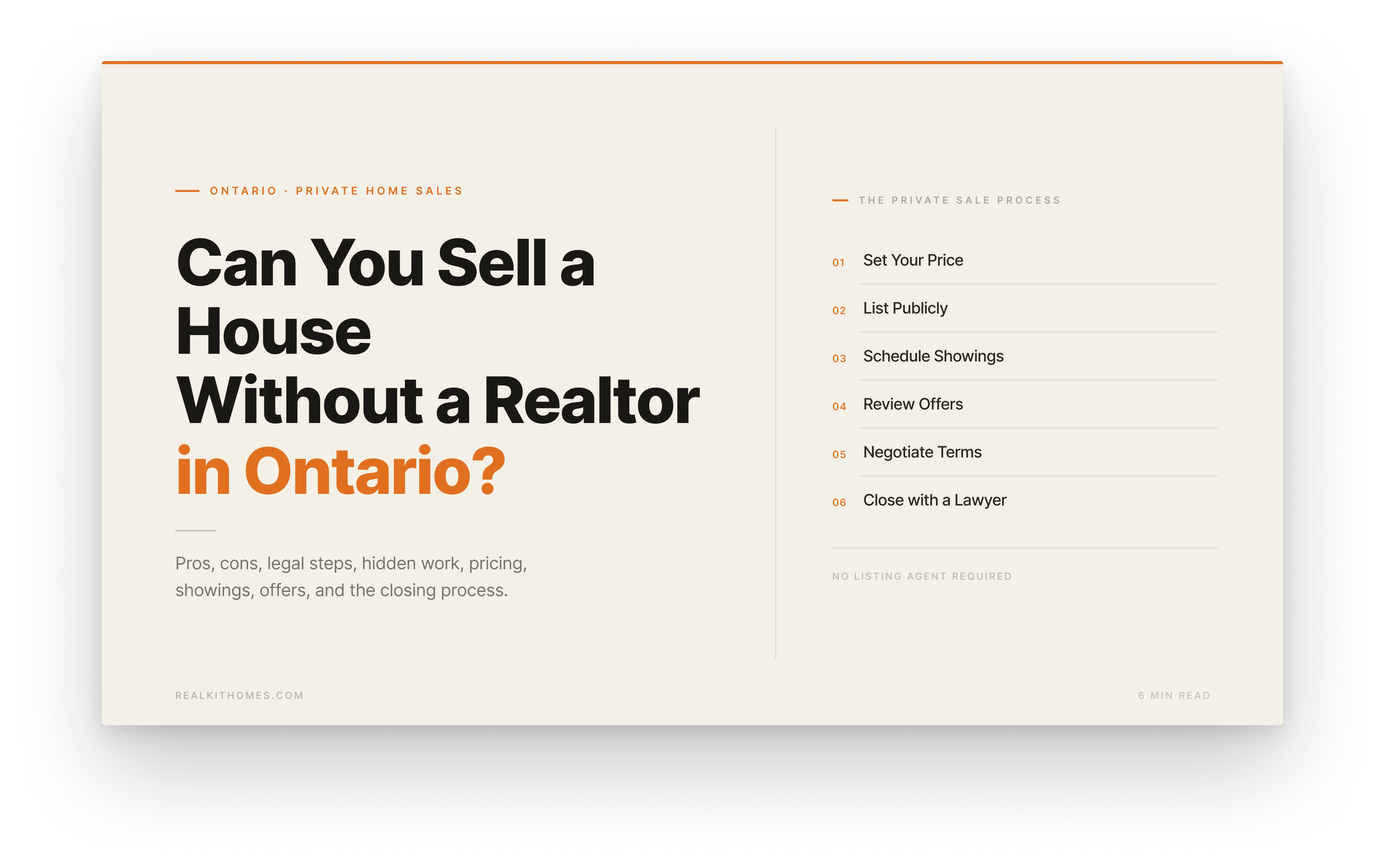
This guide walks through the real Ontario private sale process step by step. It covers the pros and cons, the hidden work that does not show up in short articles, and practical details about pricing, showings, offers, and closing that most first-time private sellers only discover halfway through.
2.What “selling without a Realtor” really means in Ontario
Selling without a Realtor in Ontario simply means you are not hiring a listing agent to represent you.
You are still selling a regular residential property, but you are taking on the role that a listing brokerage would normally play.
In practical terms, that usually means three things:
You are responsible for marketing the property
You decide how to get your home in front of buyers.
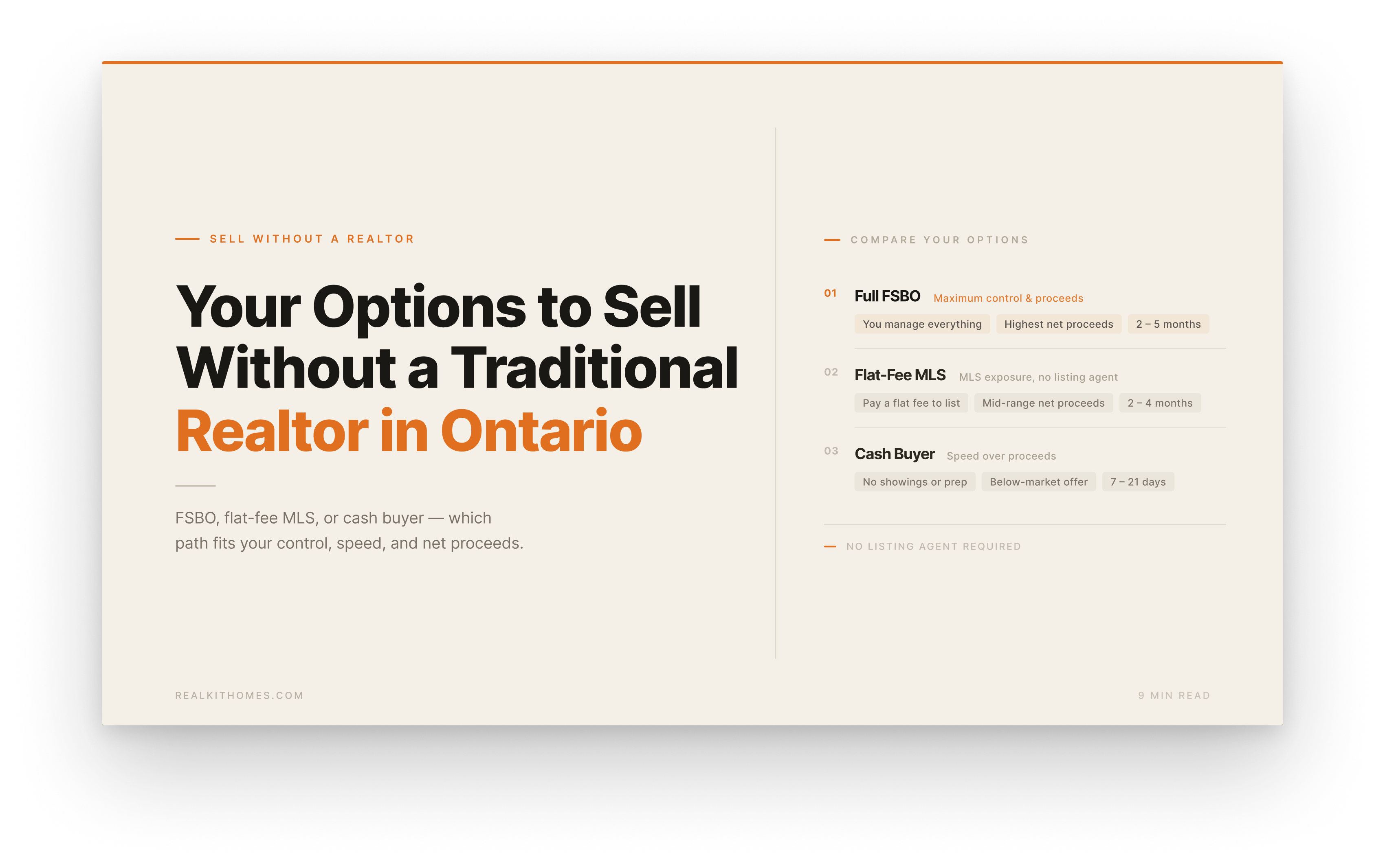
Some owners do everything privately. Others use flat-fee services or online listing platforms to get more visibility. Either way, you are the one planning how buyers will discover your home, not an agent.
You handle inquiries, showings, and follow-up
Anyone who is interested in the property will contact you (or your chosen platform) directly.
You are the one answering questions, booking showings, and following up to see whether a buyer is still interested after they have walked through.
You stay in control of offers and negotiations
Instead of reviewing offers through a listing agent, you will be the person:
- Receiving offers
- Comparing prices, conditions, and closing dates
- Deciding when to accept, reject, or counter
- Coordinating next steps with your lawyer once a deal looks serious
You are not replacing the lawyer. You are replacing the listing agent’s coordination role.
3.Is it legal to sell your own home in Ontario?
Yes, it is legal to sell your own home in Ontario without hiring a Realtor.
There is no rule that says a residential property must be sold through a brokerage.
However, “legal” does not mean “do everything yourself.”
Even in a private sale, a real estate lawyer is still a key part of the process. The lawyer is there to help with the agreement, closing documents, title transfer, and the legal steps that happen once you have a firm deal.
A simple way to think about it:
- You can choose to sell without a listing agent.
- You should still plan on using a real estate lawyer to complete the transaction properly.
4.Why Ontario homeowners think about selling without a Realtor
Ontario homeowners usually start looking at FSBO for a few specific reasons.
Potential commission savings
Commission is often one of the biggest costs when selling a home.
If you are selling a house in the GTA or any other higher-priced Ontario market, even a small change in commission structure can mean tens of thousands of dollars.
For example, if your property sells for a high price, avoiding a full listing-side commission can leave a meaningful amount of money in your pocket.
Some private sellers still choose to offer commission to a buyer’s agent, but they may save compared to paying both sides of a traditional listing.
Desire for more control
Some owners want to be involved in every step. They like the idea of:
- Setting their own showing schedule
- Talking directly with buyers
- Controlling pricing decisions
- Responding to offers without waiting for someone else
If you enjoy being hands-on and you are comfortable communicating, this kind of control can be a real advantage.
Confidence in knowing the property and neighbourhood
You live in the home. You know:
- What the natural light is like in winter
- How long it takes to walk to the nearest GO station or bus stop
- Which schools and parks are popular in your area
- What you recently renovated and why
Buyers often appreciate hearing these details directly, especially in family-oriented neighbourhoods.
5.The downsides most private sellers underestimate
The benefits are real, but so is the extra work.
Many Ontario FSBO sellers only realize how much they have taken on after the first week of showings or the first offer comes in.
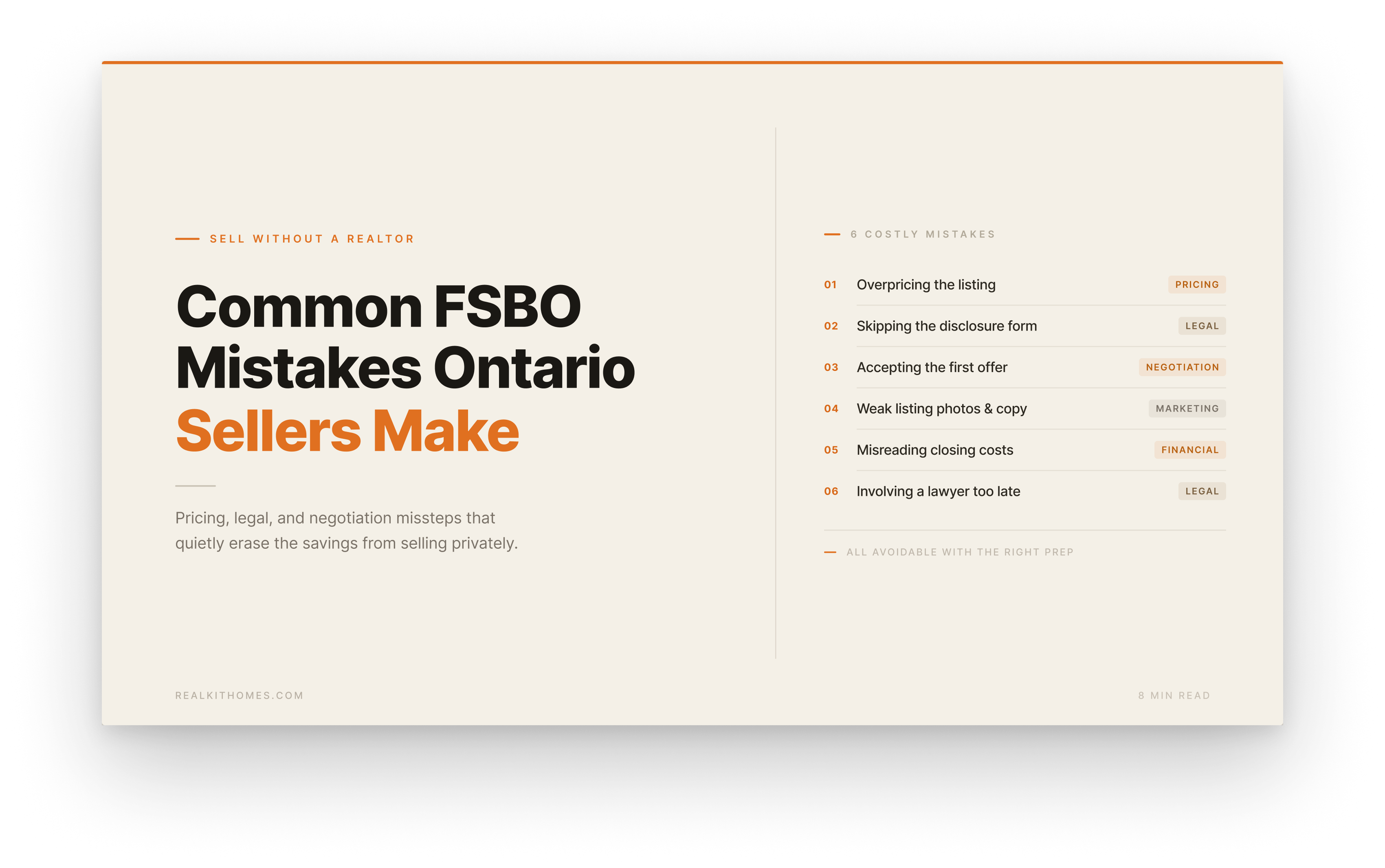
You are now responsible for pricing
Getting the price wrong is one of the most expensive mistakes you can make.
Price too high and you might see:
- Lots of views online but few showing requests
- Feedback that the property is “nice, but overpriced”
- The listing going stale, which can lead to lower offers later
Price too low and you risk:
- Leaving money on the table
- Attracting a rush of interest from bargain hunters
- Feeling pressured to accept a weak offer because you anchored everyone at a low number
In Ontario, pricing is very local. A semi-detached home in Vaughan behaves differently from a downtown Toronto condo or a bungalow in a smaller city, even at the same list price. You will need to do your own homework on recent sales, current listings, and how fast homes are actually moving in your part of the province.
You become the showing coordinator
Once your listing is live, you are the one who needs to keep the schedule under control.
That usually means:
- Responding quickly when a buyer wants to see the property
- Balancing showings with work, kids, and everyday life
- Keeping the home show-ready more often than you would like
- Handling late arrivals, cancellations, and no-shows
- Tracking who came through and what they thought
A few showings are easy. Managing back-to-back showings on a Saturday while you are still living in the home is a different experience.
You have to stay calm during negotiations
Offers are emotional. It is your home, your money, and your timeline.
Without a buffer, it is easy to react too quickly.
You will need to look beyond the top-line price and consider:
- Deposit amount
- Conditions (financing, inspection, sale of buyer’s property, condo status certificate, etc.)
- Closing date and how it lines up with your next move
- Any unusual clauses or requests
- Whether the buyer appears organized and serious
If you are not comfortable with back-and-forth negotiation, this part of the process can be stressful.
You still may deal with buyer agents
Even if you are selling privately, some buyers will be working with their own agents.
You may have to decide whether you are open to cooperating with buyer agents and what, if anything, you are prepared to offer in terms of commission on that side.
If you have never thought about that before, it can feel like a curveball when the first agent calls on behalf of their client.
7.The private sale process in Ontario, step by step
Let’s go through what actually happens from the day you decide to sell until closing, assuming you are doing a private sale.
Step 1: Get your information and property ready
Before you list, gather the basics:
- Legal address and correct lot/condo description
- Number of bedrooms, bathrooms, and parking spaces
- Square footage (if you have a reliable source)
- Recent upgrades and approximate dates
- Property tax amount from your most recent bill
- Condo fees and inclusions, if applicable
- Any known issues or repairs needed
- Inclusions and exclusions (appliances, light fixtures, window coverings, etc.)
- Preferred or acceptable closing dates
For condos, think ahead about status certificates and building rules.
For houses, think about any work done without permits, easements, or quirks a lawyer or buyer might later ask about.
Step 2: Decide on pricing for your Ontario market
You will need to look at recent comparable sales, not just active listings.
Pay attention to:
- Location (same city and, ideally, similar neighbourhood)
- Property type (detached, semi, townhouse, condo)
- Size and layout
- Age and condition
- Renovations or lack of updates
- Days on market and whether there were price changes
Try to think like a buyer comparing options in your price range.
If similar homes have been selling quickly at a certain price, and your home is inferior or superior on key points, that should influence your decision.
Step 3: Create and publish your listing
A good listing for an Ontario private sale should include:
- Clear, bright photos that show the main rooms, exterior, and any key features
- A straightforward property description in plain language
- Accurate property details (beds, baths, parking, lot size, taxes, condo fees)
- Basic information about the neighbourhood (schools, transit, parks)
- Clear showing instructions and how buyers should contact you
Avoid exaggeration. Buyers will notice when the home does not match the listing.
Step 4: Manage showings and screening
Once the listing is live, you need a system for showings.
Practical steps:
- Decide which days and time windows work best for your household
- Ask basic screening questions if someone seems vague about their situation
- Confirm appointments and send reminders
- Keep doors, lights, and access simple for buyers
- Take brief notes after each showing about the buyer and their feedback
Some private sellers use a shared calendar or a tool like Realkit to manage requests and confirmations so they do not lose track as interest builds.
Step 5: Review and compare offers
When an offer comes in, do not rush. Look at:
- Price
- Deposit amount and timing
- Conditions (and how long the buyer wants for each)
- Closing date
- Chattels and fixtures included or excluded
- Any additional clauses that could affect your risk or timing
If you receive more than one offer, you can compare these elements side by side.
Sometimes a slightly lower price with stronger conditions, a firm buyer, or better timing is actually a safer and more practical choice.
Step 6: Involve your lawyer
Once an offer seems serious, or if you are uncertain about particular clauses, it is time to involve your real estate lawyer.
They can help you understand:
- What the language in the agreement actually commits you to
- Which parts of the deal may create risk or practical issues
- What to watch for regarding title, closing documents, and funds
- How the transaction will progress after conditions are satisfied
You are not expected to handle legal fine print or closing logistics yourself. The key is to bring your lawyer into the process early enough for their advice to actually shape your decisions.
Step 7: Work through conditions and closing preparation
If the accepted offer has conditions (for example, financing, inspection, or a condo status review), there will be a period where things are happening behind the scenes:
- The buyer works with their lender and possibly a mortgage broker
- An inspection may be scheduled and completed
- Condo documents may be reviewed
- Both lawyers start preparing for closing
Your role during this stage is to cooperate with reasonable inspection access, provide requested documents within reason, and stay responsive to your lawyer’s questions.
Step 8: Closing day and key handover
As closing day approaches, your lawyer will guide the final steps.
On or before closing, you will typically:
- Sign required closing documents
- Confirm final arrangements for keys and access
- Move out and leave the property in the agreed condition
- Coordinate utilities and final readings according to your lawyer’s instructions
Once funds are properly transferred and the title is registered, the buyer’s lawyer will confirm that the transaction is complete.
At that point, keys are released and your private sale is officially closed.
8.How buyers see a private sale in Ontario
Buyers do not expect you to act like a professional agent.
They do expect the process to feel fair, organized, and safe.
From a buyer’s perspective, a strong private sale experience includes:
- Clear information up front
- Reasonably quick responses to questions
- Safe and predictable showings
- A straightforward way to submit offers and receive updates
- Confidence that lawyers will be involved and that closing will be handled properly
If the process feels chaotic or improvised, some buyers (and their advisors) may see that as a risk, even if they like the property itself.
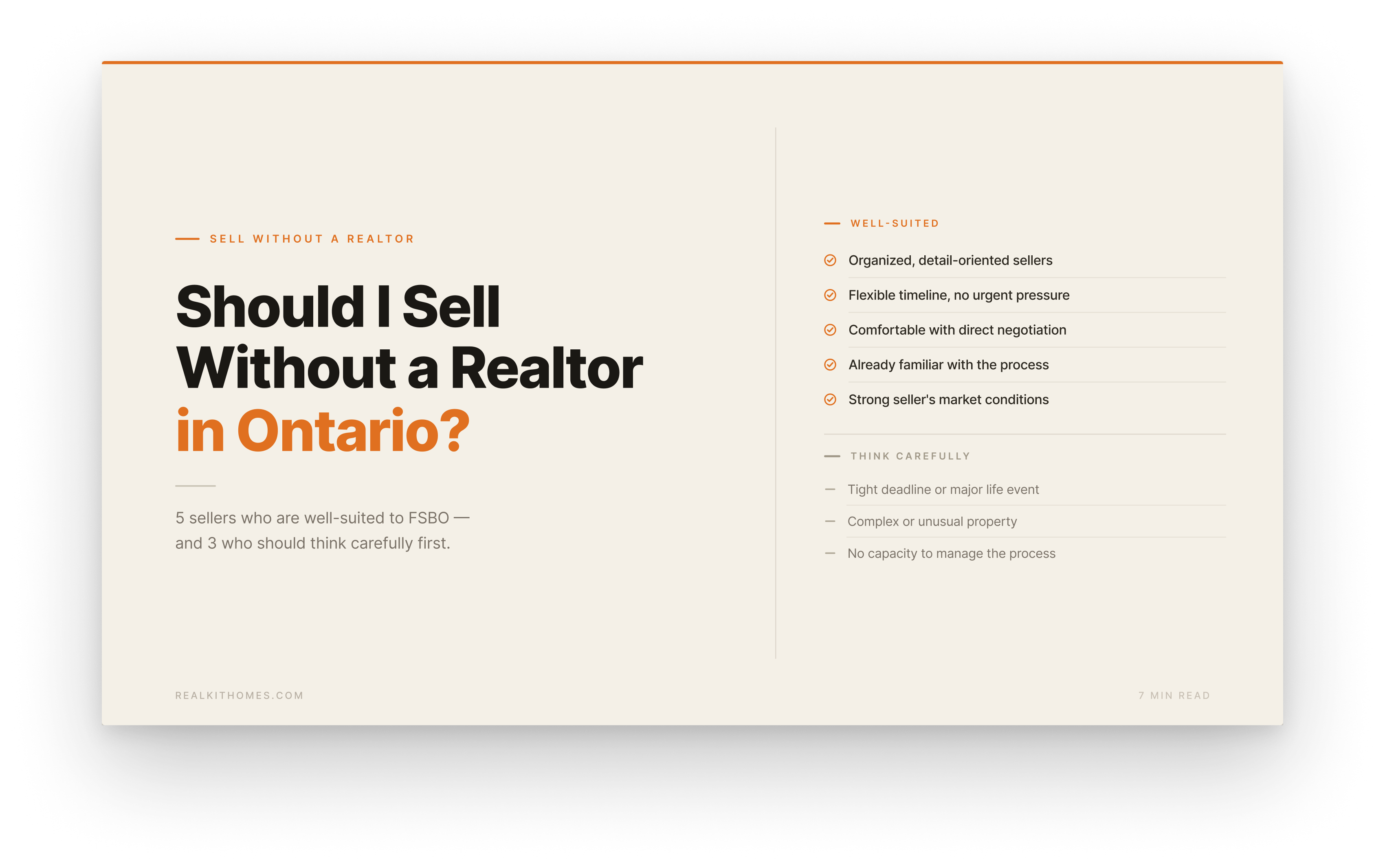
9.When selling without a Realtor makes sense
A private sale can be a good fit in Ontario if:
- You are comfortable communicating with strangers and answering questions
- You can respond quickly to messages and showing requests
- You are willing to learn the process and stay organized
- Your property is relatively straightforward (for example, an owner-occupied freehold home)
- You are realistic about pricing and flexible enough to adjust if needed
- You are ready to involve a lawyer when offer discussions get serious
For some homeowners, this approach fits their personality and priorities very well.
They like being hands-on and they care more about net proceeds than outsourcing all of the work.
10.When a private sale may not be the best option
Selling without a Realtor may not be ideal if:
- You have very limited time to manage inquiries and showings
- You strongly dislike negotiation or conflict
- The property has complex legal, tenancy, or title issues
- You are easily overwhelmed by paperwork and deadlines
- You prefer having a professional buffer between you and buyers
- You are likely to ignore messages or procrastinate on important decisions
In those situations, even if a private sale could save commission on paper, the practical stress and risk might outweigh the benefit.
11.Where a platform like Realkit fits in
A private sale does not have to mean you manage everything with just your phone and email.
The hard part in many FSBO transactions is not finding interest, but keeping the entire process organized from the first showing request to closing.
Realkit is built specifically for that coordination problem.
Instead of relying on scattered text threads and spreadsheets, a seller can:
- Manage showing requests and availability in one place
- Keep buyer communication in a shared thread tied to the listing
- Collect and compare offers inside a single workspace
- Track transaction milestones as lawyers and mortgage professionals do their work
It does not replace your lawyer or give legal advice.
It helps make the operational side of a private sale more manageable, so you can focus on good decisions instead of chasing paperwork.
13.Sources
- Government of Ontario – information on real estate transactions, consumer protection, and working with real estate professionals in Ontario.
- Law Society of Ontario – resources on the role of real estate lawyers and the importance of legal advice in property transactions.
- Ontario real estate law firm blogs and guides outlining typical closing steps, the use of Agreements of Purchase and Sale, and the roles of buyer and seller lawyers.
- Ontario-focused private sale and FSBO resources explaining common steps in selling a home without a listing agent, including pricing, showings, offers, and lawyer involvement.