1.Selling Privately in Mississauga
Yes, you can sell your own home privately in Mississauga without hiring a listing Realtor. You can set the price, market the property, speak directly with buyers, book showings, review written offers, negotiate terms, and work with a real estate lawyer to complete the closing.
Private selling means you take responsibility for the work that would normally sit with a listing representative. That includes pricing, preparing the home, creating accurate listing information, managing inquiries, screening visitors, arranging showings, organizing documents, handling offer versions, and staying on top of deadlines.
Mississauga has a broad mix of housing, from high-rise condos near Square One and Port Credit to detached homes, semis, townhouses, and newer developments across areas such as Erin Mills, Churchill Meadows, Meadowvale, Cooksville, Clarkson, and Lisgar. Buyers may compare your home against very different alternatives depending on their commute, school preferences, parking needs, access to GO Transit, condo fees, and desired amount of space.
A private sale can be a practical path if you are comfortable managing the process and involving the right professionals when needed. It is not simply about putting up a sign. It is about running a well-organized Ontario real estate transaction from listing through closing.
Before choosing FSBO, it helps to understand the time and responsibility involved beyond the potential savings.
2.Is Private Selling Legal in Mississauga?
A homeowner can sell their own property privately in Mississauga. You do not need to use a listing Realtor to sell a home you own.
However, selling privately does not remove the legal steps that come with an Ontario real estate transaction. A real estate lawyer is normally involved to review the legal documents, address title matters, coordinate closing funds, deal with mortgage discharge if applicable, and complete the transfer of ownership.
Buyers may have their own agent. That agent represents the buyer, not you, and may request a showing, ask questions, submit an offer, and negotiate on the buyer’s behalf. You can decide how you want to work with buyer agents and whether your strategy includes compensation for a buyer representative.
Speak with an Ontario real estate lawyer before signing a serious offer and whenever you are unsure about disclosure, title, tenants, conditions, counteroffers, ownership, or closing obligations. A lawyer can advise on your specific situation. This guide provides practical information, not legal advice.
3.Mississauga Property Considerations
Mississauga is not one uniform housing market. A two-bedroom condo in City Centre, a townhouse in Churchill Meadows, and a detached home in Lorne Park can attract different buyers and require different preparation.
Condos and high-rise apartments
Condominiums are a significant part of Mississauga’s housing mix, particularly around City Centre, Cooksville, Port Credit, and Hurontario. Private condo sellers should be ready for questions that go beyond the unit itself.
Buyers may ask about:
- Monthly condominium fees and what they include
- Parking and locker ownership or rental arrangements
- Building amenities
- Pet, renovation, moving, and short-term rental rules
- Visitor parking and concierge procedures
- Reserve fund information
- Current or planned building work
- Special assessments
- Elevator booking requirements
A buyer may make their purchase conditional on reviewing the status certificate and related condominium documents. Requesting current documents early can make your sale easier to manage when a serious buyer asks for them.
Your lawyer can explain which condominium documents matter for your transaction and how they should be handled. Avoid making assumptions about the legal status of parking, lockers, rentals, or building rules without checking the relevant records.
Freehold homes and townhouses
For detached homes, semis, and freehold townhouses, buyers will often look closely at details that are especially important in Mississauga family-home searches.
These can include:
- Driveway capacity and garage parking
- Finished basements and separate entrances
- Lot size, backyard use, and outdoor space
- Commute access to highways, GO stations, and transit
- Nearby schools, parks, and shopping
- Furnace, air conditioner, roof, windows, and plumbing updates
- Basement moisture history or sump pump information
- Renovation records, permits, and warranties where available
Be precise in your listing. If a basement has a separate entrance, describe that fact. Do not present it as a legal suite, income unit, or additional dwelling unless you have reliable information supporting that description.
Tenanted properties
A tenanted Mississauga property can still be sold privately, but it requires more planning. Buyers may ask for lease information, current rent, access expectations, possession terms, and details about the tenancy.
Do not assume that selling a property automatically determines when a tenant must leave. Tenant rights, access for showings, purchaser plans, and possession can affect the sale. Speak with a lawyer early if your property is tenanted so your listing, showings, offer terms, and expected closing timeline are handled appropriately.
4.Pricing Your Home in Mississauga
A Mississauga-wide average is not enough to price your home properly. The difference between neighbourhoods, property types, layouts, school areas, condo buildings, and parking arrangements can be substantial.
Your price should be based on meaningful comparable properties, not just the highest recent sale you can find.
Look at:
- Recent sales of similar homes
- Current listings competing for the same buyers
- Listings that have been sitting, cancelled, relisted, or reduced
- Property type and layout
- Interior condition and renovations
- Lot size, location, and parking
- Basement finish and functionality
- Condo fees, amenities, building age, and unit features
- Sale timing and current buyer competition
A renovated detached home with a double garage in one part of Mississauga is not directly comparable with an older home of similar size on a busier road. The same applies to condos. A unit with parking, a locker, lower monthly fees, and unobstructed views may attract different buyers than a similar-sized unit without those features.
An illustrative pricing example
This example is illustrative only. It is not current Mississauga market data.
Imagine you own a three-bedroom townhouse with a garage and finished basement. You find several recent sales nearby. One sold at a higher price after a full kitchen renovation and new flooring throughout. Another sold lower because it had no finished basement and less parking. A third had a similar layout but backed onto a busy road.
Instead of choosing the highest sale as your asking price, you would compare the specific differences. Review your condition, upgrades, outdoor space, parking, road location, monthly fees if applicable, and what buyers can currently choose in the same price range.
That process helps you choose a price that makes sense to buyers from the first week, when interest is often strongest.
Avoiding overpricing and underpricing
Overpricing can reduce showing activity, make competing homes look more attractive, and lead to later price reductions. Underpricing can also be risky if you do not have enough marketing reach or a clear plan for handling multiple interested buyers.
Your asking price should have a purpose. You may be aiming to attract early attention, position the home against active competition, match recent comparable sales, or create flexibility around closing dates and negotiation.
For a clearer look at how market comparisons differ from formal valuation, review the difference between a CMA and an appraisal before relying on one number alone.
When outside pricing help makes sense
Consider an independent appraisal or professional pricing input if:
- Your property is difficult to compare
- You own a unique, custom-built, waterfront-adjacent, or high-value home
- You have completed a substantial addition or renovation
- There are few recent comparable sales
- Multiple owners or family members disagree about value
- You need an independent reference point before listing
An appraisal or pricing opinion can help inform your strategy, but it does not guarantee what a buyer will offer or what a lender will support.
5.Private-Sale Costs and Commission Context
Selling privately may reduce or remove the cost of using a traditional listing representative, but it does not make a sale cost-free.
Your costs may include:
- Legal fees and disbursements
- Mortgage payout, discharge, or prepayment costs where applicable
- Cleaning, repairs, painting, staging, and photography
- Advertising or listing-platform costs
- Moving and storage
- Condominium document costs, if applicable
- Buyer-agent compensation, if you choose to offer it
- Property-tax, utility, condominium-fee, or other closing adjustments
Commission structures and amounts vary. Some private sellers choose to offer compensation to a buyer’s representative because many buyers are working with agents. Others choose not to. Either approach can affect buyer interest, negotiations, and the overall outcome.
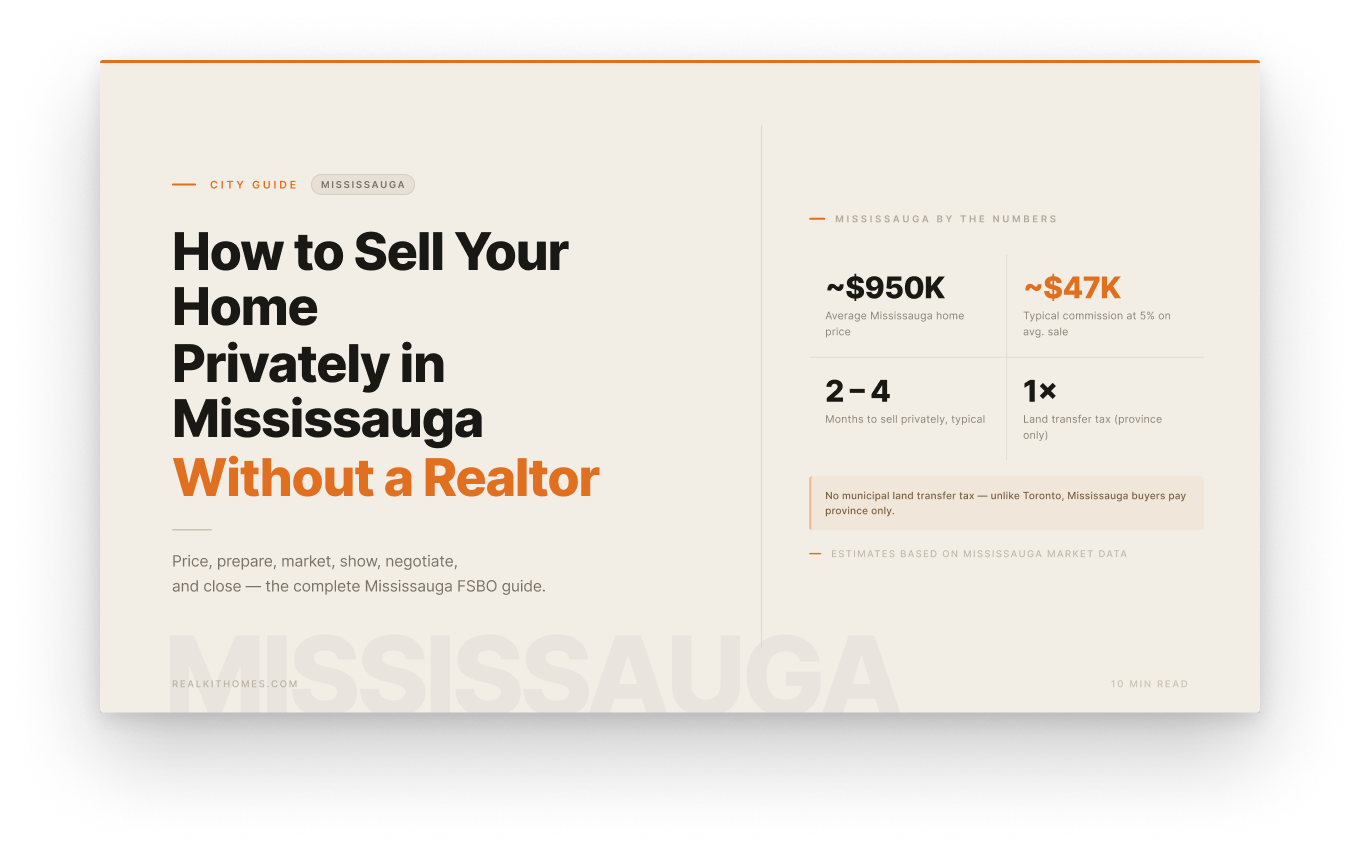
Land transfer tax is generally a buyer-side cost. Mississauga buyers typically deal with Ontario land transfer tax, while Toronto’s separate municipal land transfer tax does not apply to a Mississauga purchase. It is still helpful for a seller to understand the buyer’s overall budget, especially during negotiations.
An illustrative cost comparison
This example is illustrative only. It is not a quote, commission estimate, or prediction of your final result.
Imagine two ways to sell the same Mississauga home.
In one path, the seller hires a full-service listing representative and agrees to the applicable listing and buyer-representation compensation structure.
In the other path, the seller manages the sale privately, pays for preparation, legal services, photography or marketing, and any buyer-agent compensation they choose to offer.
The private-sale route may change some costs, but the seller should compare the complete outcome: expected sale price, time required, marketing reach, home preparation, buyer-agent strategy, legal costs, potential price reductions, and the risk of a deal not proceeding.
The most useful question is not simply what commission may be avoided. It is which option gives you the best overall result after costs, time, and risk are considered.
6.Prepare Before You List
Preparation has a direct effect on buyer confidence. A clean, accurate, well-documented listing makes it easier for people to understand the home and decide whether to book a showing.
Prepare the home buyers will see
Start with the visible details that affect first impressions:
- Clean and declutter the entrance, kitchen, bathrooms, bedrooms, and main living spaces
- Repair small visible issues such as dripping faucets, damaged caulking, loose handles, scuffed walls, and burnt-out bulbs
- Remove personal documents, medications, valuables, spare keys, and sensitive mail
- Make exterior access, house numbers, walkways, and lighting easy to use
- Ensure rooms can be photographed and shown comfortably
- Consider how the home looks during daytime and evening showing hours
For condos, consider the experience from the building entrance to the suite. Confirm visitor parking, concierge requirements, elevator use, and whether buyers can easily access parking, lockers, or amenities during a showing.
Build a private-sale document file
Before listing, gather as much of the following as you can:
- Current property-tax information
- Recent utility information
- Details and dates for major improvements
- Renovation invoices, permits, warranties, and manuals where available
- Survey or reference plan, if you have one
- Mortgage information for your own planning
- Condominium fee details and available building documents, where applicable
- Lease and tenancy documents, if applicable
- A written list of inclusions and exclusions
Useful inclusions and exclusions often include appliances, window coverings, light fixtures, garage-door openers, security equipment, storage sheds, or wall-mounted televisions. Write down what stays and what does not before an offer arrives.
A well-organized document file prevents rushed answers when buyers, agents, lawyers, inspectors, or lenders request information.
Handle known issues carefully
Do not hide behind vague listing language when you know about a significant issue. Water events, foundation concerns, renovation history, unpermitted work, shared access, tenant matters, and condominium issues can all require careful handling.
If you are uncertain what should be disclosed or how a known issue could affect your sale, speak with your lawyer before making representations to buyers.
7.Marketing, Buyer Inquiries, and Showings
A strong private listing should make the essentials clear without overstating the property.
Include accurate information about:
- Property type and location
- Bedrooms, bathrooms, parking, and outdoor space
- Major updates, where you can support the details
- Condo fees and inclusions, where relevant
- Appliances and other included items
- Lot, basement, storage, locker, or garage details
- Clear, well-lit photos that accurately represent the home
The purpose is to help serious buyers decide whether to visit. You do not need to reveal every personal detail about the home or your plans.
Keep buyer conversations organized
Private sellers often receive inquiries through text messages, email, phone calls, social media, and listing platforms. This becomes difficult when several people request showings, ask for documents, or follow up after visiting.
Keep a written record of:
- Buyer or agent name
- Contact information
- Showing date and time
- Questions asked
- Documents shared
- Feedback received
- Indications of financing readiness or serious interest
Use one place to track those details. Relying on memory or scattered messages can cause missed appointments, inconsistent information, or confusion during negotiations.
Screen and show safely
Not every inquiry needs an immediate showing.
Before booking, confirm the visitor’s name, contact information, whether they are working with an agent, and their preferred appointment time. Use scheduled appointments instead of accepting unannounced visits.
For safer showings:
- Secure valuables, medication, financial documents, and spare keys
- Avoid sharing unnecessary personal information
- Keep a record of who attended
- Let someone know when a showing is scheduled
- Consider having another adult present or nearby
- Use clear access instructions instead of leaving doors unlocked
- Do not allow unsupervised access to storage rooms, garages, utility areas, or private offices
Mississauga showing logistics
Mississauga buyers may arrive by car, so parking instructions matter. Let visitors know whether they should use the driveway, visitor parking, street parking, or a designated condominium area.
For condos, confirm:
- Concierge and sign-in procedures
- Visitor parking availability
- Elevator restrictions or booking requirements
- Building rules for open houses
- Access to parking spots, lockers, or amenities
- Whether fobs or elevator access are needed
For freehold homes, be ready to explain driveway capacity, shared-driveway arrangements, side entrances, backyard access, and any roadwork or construction that may affect arrival.
Showing-day checklist
Before each showing:
- Open blinds and turn on key lights
- Tidy kitchens, bathrooms, and entry areas
- Secure personal information and valuables
- Make a plan for pets
- Confirm the appointment and access instructions
- Ensure parking or visitor instructions are clear
- Make basic property details available
- Keep the space comfortable and easy to walk through
- Record feedback promptly after the viewing
Private sellers often underestimate the ongoing scheduling and follow-up work that begins once the listing is live.
[Internal Link: What FSBO Really Looks Like Day-to-Day for an Ontario Homeowner]
8.Offers and Negotiation
The highest price is not always the strongest offer.
A higher offer may come with uncertain financing, a long condition period, a difficult closing date, vague inclusions, or terms that do not work for your move. A slightly lower offer with clearer financing, manageable conditions, and a better closing date may be more practical.
When you receive a written offer, consider:
- Purchase price
- Deposit amount and proposed timing
- Financing conditions and deadlines
- Inspection conditions and deadlines
- Status-certificate conditions for condos
- Sale-of-property conditions, if any
- Closing date
- Inclusions and exclusions
- Requested repairs, credits, or additional access
- Buyer readiness and the clarity of the offer
Verbal interest is not a binding agreement. A buyer saying they are prepared to pay your asking price does not mean you have a completed deal.
Review offers with a lawyer
A serious offer is the right time to involve your real estate lawyer. They can review the Agreement of Purchase and Sale, explain terms, identify issues to consider, and help you understand the effect of conditions, amendments, and deadlines.
Do not make important commitments through informal text messages or phone calls. If a term changes, make sure it is properly reflected in the written agreement with appropriate legal guidance.
Keep counteroffers and deadlines clear
Private negotiations can become confusing when several offer versions circulate through email, text, and different people.
Track each version clearly:
- When it was received
- Which terms changed
- Who signed it
- Whether it remains open
- Its response deadline
- What your lawyer has reviewed
Realkit can help keep buyer conversations, written offers, counteroffers, and transaction milestones organized in one workspace. It does not provide legal advice, but it can make the operational side of private negotiations easier to follow.
If buyer agents are likely to bring clients to your listing, decide in advance how you will communicate and what your approach is to buyer-agent compensation.
9.After an Offer Is Accepted
Accepted, firm, and closed are different stages.
An accepted offer may still have conditions. For example, a buyer may need to arrange financing, complete an inspection, review a condominium status certificate, sell another property, or satisfy another condition included in the agreement.
A deal becomes firm only after conditions are fulfilled, waived, or otherwise handled according to the agreement. Closing happens later, when the lawyers complete the legal work, funds are transferred, title is registered, and possession is provided under the agreed terms.
During the conditional period
During this stage, you may need to:
- Provide agreed documents
- Coordinate inspection or appraisal access
- Respond to appropriate buyer questions
- Track condition deadlines
- Speak with your lawyer before agreeing to extensions or amendments
The buyer’s mortgage broker, lender, or appraiser may become involved during the financing process. The buyer’s financing is primarily their responsibility, but it can affect your transaction timeline.
Before closing
As closing approaches, your lawyer will handle much of the legal coordination. You may need to provide identification, mortgage information, utility details, keys, garage remotes, fobs, or other documents.
Stay responsive to your lawyer. Last-minute delays can be harder to resolve as the closing date approaches.
You should also plan the practical side of moving:
- Final cleaning
- Utility account changes
- Key, fob, and garage remote arrangements
- Mail forwarding
- Removal of excluded items
- Condominium move bookings, if applicable
For a detailed breakdown of what happens after a deal moves forward, review the Ontario closing timeline before you reach the conditional stage.
10.How Realkit Helps Private Sellers in Mississauga
A private sale can become difficult to manage when buyer messages, showing appointments, documents, offers, and deadlines are spread across several apps and inboxes.
Realkit helps sellers create and manage a private listing, coordinate showings, keep buyer messages and activity organized, manage versioned offers and negotiations, track an accepted transaction, and coordinate with lawyers and mortgage professionals.
Realkit is not a brokerage, law firm, lender, escrow provider, deposit holder, title insurer, or guarantor of a completed sale. It does not provide legal advice, replace a lawyer, hold deposits or closing funds, guarantee a sale, or guarantee financing.
11.Common Mistakes to Avoid
Using broad Mississauga averages to price a specific home
A city-wide average does not account for property type, neighbourhood, parking, lot size, building, condo fees, condition, or buyer demand. Price against genuinely comparable homes, not the broadest available number.
Listing a condo without building details ready
Condo buyers may need information about fees, parking, lockers, amenities, rules, status certificates, special assessments, and move procedures. Delays or incomplete answers can weaken buyer confidence.
Assuming every buyer inquiry is serious
A private sale requires a process for screening, booking, and following up with buyers. Unmanaged inquiries can lead to wasted time, missed showings, or safety concerns.
Losing track of conversations and documents
If buyer messages are split between text, email, social media, and phone calls, it becomes easy to forget what you told someone or miss a deadline. Keep one clear record of buyer activity and shared documents.
Looking only at the offer price
Review the full offer, including financing, conditions, deposit, closing date, inclusions, and buyer readiness. A higher price does not automatically mean a better transaction.
Making informal counteroffers
A text or verbal conversation about a changed price or closing date can create confusion. Use written offer documents, track versions clearly, and speak with your lawyer before committing to revised terms.
Waiting too long to contact a lawyer
Choose a real estate lawyer before you start receiving serious interest. Finding one after an offer arrives can create unnecessary pressure during a short response window.
13.Sources
- City of Mississauga: Property Taxes
- City of Mississauga: Moving and Changing Your Address
- Peel Region: Water Billing and Account Information
- Toronto Regional Real Estate Board: Market Watch
- Toronto Regional Real Estate Board: Market Data
- Government of Ontario: Land Transfer Tax
- Appraisal Institute of Canada: For Residential Property Owners
- Appraisal Institute of Canada: For Mortgage Professionals
- Condominium Authority of Ontario: Status Certificates